Pearson+ LogoPearson+ Logo
Ch. 7 - Sex Determination and Sex Chromosomes
Klug - Concepts of Genetics  12th Edition
Klug12th EditionConcepts of Genetics ISBN: 9780135564776Not the one you use?Change textbook
Chapter 7, Problem 6

How do mammals, including humans, solve the 'dosage problem' caused by the presence of an X and Y chromosome in one sex and two X chromosomes in the other sex?

Verified step by step guidance
1
Understand the 'dosage problem': In mammals, females have two X chromosomes (XX) while males have one X and one Y chromosome (XY). Since the X chromosome carries many genes, having two copies in females could lead to double the gene expression compared to males, which would disrupt cellular balance.
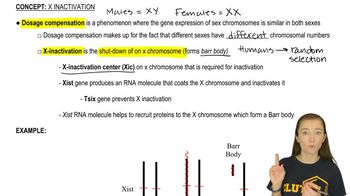
Recognize the mechanism mammals use to balance gene expression: To solve this dosage imbalance, mammals employ a process called X-chromosome inactivation (XCI), where one of the two X chromosomes in females is largely silenced.
Learn how X-chromosome inactivation occurs: Early in embryonic development, one X chromosome in each female cell is randomly chosen to be inactivated. This inactivation is stable and passed on to daughter cells, ensuring consistent gene expression levels.
Explore the molecular basis of XCI: The inactivated X chromosome condenses into a structure called a Barr body. This process involves the expression of the XIST gene, which produces RNA that coats the X chromosome and triggers its silencing.
Summarize the outcome: Through X-chromosome inactivation, females effectively have one functional X chromosome per cell, equalizing the dosage of X-linked genes between males and females and maintaining genetic balance.

Verified video answer for a similar problem:

This video solution was recommended by our tutors as helpful for the problem above.
Video duration:
1m
Was this helpful?

Key Concepts

Here are the essential concepts you must grasp in order to answer the question correctly.

Sex Chromosomes and Dosage Imbalance

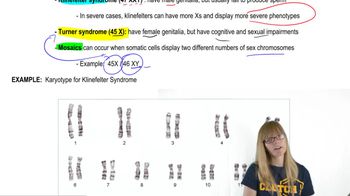
In mammals, females have two X chromosomes while males have one X and one Y chromosome. This difference creates a potential imbalance in the expression of genes located on the X chromosome, known as the dosage problem, because females could produce twice the amount of X-linked gene products compared to males.
Recommended video:
Guided course
10:35
Human Sex Chromosomes

X-Chromosome Inactivation

To address the dosage problem, female mammals undergo X-chromosome inactivation, where one of the two X chromosomes is largely silenced in each cell. This process equalizes gene expression between males and females by ensuring that only one functional X chromosome is active per cell.
Recommended video:
Guided course
09:30
X-Inactivation

Role of the Y Chromosome

The Y chromosome is much smaller and contains fewer genes, many related to male sex determination and spermatogenesis. It does not compensate for the dosage of X-linked genes, so dosage compensation mechanisms like X-inactivation are essential to balance gene expression between sexes.
Recommended video:
Guided course
10:35
Human Sex Chromosomes