Pearson+ LogoPearson+ Logo
Ch. 8 - Chromosome Mutations: Variation in Number and Arrangement
Klug - Concepts of Genetics  12th Edition
Klug12th EditionConcepts of Genetics ISBN: 9780135564776Not the one you use?Change textbook
Chapter 8, Problem 16

Certain varieties of chrysanthemums contain 18, 36, 54, 72, and 90 chromosomes; all are multiples of a basic set of nine chromosomes. How would you describe these varieties genetically? What feature do the karyotypes of each variety share? A variety with 27 chromosomes has been discovered, but it is sterile. Why?

Verified step by step guidance
1
Identify the basic chromosome number (x) for chrysanthemums, which is given as 9. This represents the number of chromosomes in a single complete set.
Recognize that the varieties with 18, 36, 54, 72, and 90 chromosomes have chromosome numbers that are multiples of 9, indicating they are polyploids. Specifically, determine the ploidy level (number of sets) by dividing the total chromosome number by the basic set number: \(\text{Ploidy level} = \frac{\text{Total chromosomes}}{9}\).
Describe these varieties as diploid (2x = 18), tetraploid (4x = 36), hexaploid (6x = 54), octoploid (8x = 72), and decaploid (10x = 90), respectively, based on their chromosome counts.
Explain that the shared feature of the karyotypes is that all chromosomes are organized in complete sets of nine, meaning each variety has an integral number of these basic sets without any partial sets.
For the variety with 27 chromosomes, note that it is a triploid (3x = 27), which often leads to sterility because during meiosis, the odd number of chromosome sets cannot pair evenly, resulting in unbalanced gametes and thus infertility.

Verified video answer for a similar problem:

This video solution was recommended by our tutors as helpful for the problem above.
Video duration:
1m
Was this helpful?

Key Concepts

Here are the essential concepts you must grasp in order to answer the question correctly.

Polyploidy

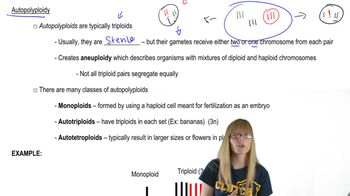
Polyploidy refers to the condition where an organism has more than two complete sets of chromosomes. In chrysanthemums, chromosome numbers like 18, 36, 54, 72, and 90 indicate multiples of a basic set of nine chromosomes, showing different levels of polyploidy (diploid, tetraploid, etc.). This genetic feature often affects traits like size and fertility.
Recommended video:
Guided course
04:03
Autopolyploidy

Basic Chromosome Number (Monoploid Number)

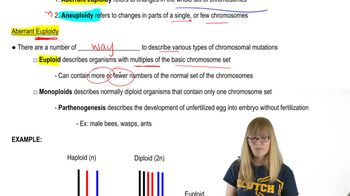
The basic chromosome number is the number of distinct chromosomes in a single complete set (denoted as 'x'). For chrysanthemums, x = 9, meaning all varieties have chromosome counts that are multiples of nine. This concept helps classify the genetic makeup and understand the relationship between different varieties.
Recommended video:
Guided course
08:42
Aberrant Euploid

Sterility in Odd-Numbered Polyploids

Organisms with an odd number of chromosome sets, like the 27-chromosome chrysanthemum (3x9), often experience sterility due to irregular chromosome pairing during meiosis. This leads to unbalanced gametes, preventing successful reproduction, which explains why the 27-chromosome variety is sterile.
Recommended video:
Guided course
04:03
Autopolyploidy
Related Practice
Textbook Question

Discuss Ohno's hypothesis on the role of gene duplication in the process of evolution. What evidence supports this hypothesis?

584
views
Textbook Question
What roles have inversions and translocations played in the evolutionary process?
914
views
Textbook Question

The primrose, Primula kewensis, has 36 chromosomes that are similar in appearance to the chromosomes in two related species, P. floribunda (2n=18) and P. verticillata (2n=18). How could P. kewensis arise from these species? How would you describe P. kewensis in genetic terms?

894
views
Textbook Question

Drosophila may be monosomic for chromosome 4, yet remain fertile. Contrast the F₁ and F₂ results of the following crosses involving the recessive chromosome 4 trait, bent bristles:

monosomic IV, bent bristles x diploid, normal bristles

520
views
Textbook Question

Drosophila may be monosomic for chromosome 4, yet remain fertile. Contrast the F₁ and F₂ results of the following crosses involving the recessive chromosome 4 trait, bent bristles:

monosomic IV, normal bristles x diploid, bent bristles.

536
views
Textbook Question

Mendelian ratios are modified in crosses involving autotetraploids. Assume that one plant expresses the dominant trait green seeds and is homozygous (WWWW). This plant is crossed to one with white seeds that is also homozygous (wwww). If only one dominant allele is sufficient to produce green seeds, predict the F₁ and F₂ results of such a cross. Assume that synapsis between chromosome pairs is random during meiosis.

710
views