Pearson+ LogoPearson+ Logo
Ch. 8 - Chromosome Mutations: Variation in Number and Arrangement
Klug - Concepts of Genetics  12th Edition
Klug12th EditionConcepts of Genetics ISBN: 9780135564776Not the one you use?Change textbook
Chapter 8, Problem 14

What roles have inversions and translocations played in the evolutionary process?

Verified step by step guidance
1
Understand that inversions and translocations are types of chromosomal rearrangements that can affect the structure of chromosomes.
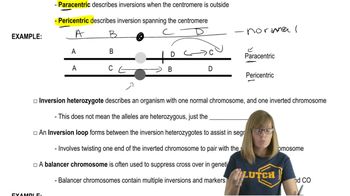
Recognize that inversions occur when a segment of a chromosome is reversed end to end, which can lead to changes in gene expression and function.
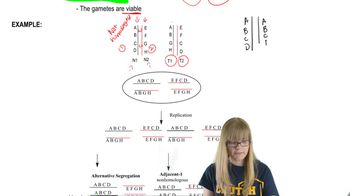
Acknowledge that translocations involve the transfer of a segment of one chromosome to another, which can create new gene combinations and potentially novel traits.
Consider how these chromosomal changes can lead to reproductive isolation and speciation by preventing successful breeding between individuals with different chromosomal arrangements.
Explore examples in nature where inversions and translocations have contributed to the adaptation and evolution of species, such as in the diversification of certain plant and animal groups.

Verified video answer for a similar problem:

This video solution was recommended by our tutors as helpful for the problem above.
Video duration:
2m
Was this helpful?

Key Concepts

Here are the essential concepts you must grasp in order to answer the question correctly.

Chromosomal Inversions

Chromosomal inversions occur when a segment of a chromosome is reversed end to end. This rearrangement can affect gene expression and recombination during meiosis, potentially leading to speciation. Inversions can preserve advantageous gene combinations and contribute to genetic diversity, influencing evolutionary trajectories.
Recommended video:

Chromosomal Translocations

Translocations involve the rearrangement of genetic material between non-homologous chromosomes. This process can create new gene combinations and alter gene regulation, which may provide adaptive advantages in changing environments. Translocations can also lead to genetic disorders, but they play a significant role in evolution by introducing variability.
Recommended video:
Guided course
12:42
Reciprocal Translocation

Evolutionary Significance of Chromosomal Rearrangements

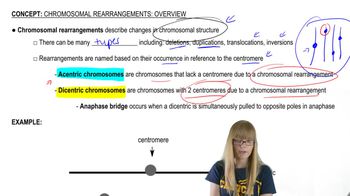
Chromosomal rearrangements, including inversions and translocations, are crucial for evolution as they can lead to new phenotypes and increased genetic diversity. These changes can facilitate adaptation to new environments and contribute to the formation of new species. Understanding these mechanisms helps explain the complexity of evolutionary processes.
Recommended video:
Guided course
04:38
Rearrangement Overview
Related Practice
Textbook Question

Contrast the genetic composition of gametes derived from tetrads of inversion heterozygotes where crossing over occurs within a paracentric versus a pericentric inversion.

900
views
Textbook Question

Human adult hemoglobin is a tetramer containing two alpha (α) and two beta (β) polypeptide chains. The α gene cluster on chromosome 16 and the β gene cluster on chromosome 11 share amino acid similarities such that 61 of the amino acids of the α-globin polypeptide (141 amino acids long) are shared in identical sequence with the β-globin polypeptide (146 amino acids long). How might one explain the existence of two polypeptides with partially shared function and structure on two different chromosomes?

567
views
Textbook Question

Discuss Ohno's hypothesis on the role of gene duplication in the process of evolution. What evidence supports this hypothesis?

584
views
Textbook Question

The primrose, Primula kewensis, has 36 chromosomes that are similar in appearance to the chromosomes in two related species, P. floribunda (2n=18) and P. verticillata (2n=18). How could P. kewensis arise from these species? How would you describe P. kewensis in genetic terms?

894
views
Textbook Question

Certain varieties of chrysanthemums contain 18, 36, 54, 72, and 90 chromosomes; all are multiples of a basic set of nine chromosomes. How would you describe these varieties genetically? What feature do the karyotypes of each variety share? A variety with 27 chromosomes has been discovered, but it is sterile. Why?

506
views
Textbook Question

Drosophila may be monosomic for chromosome 4, yet remain fertile. Contrast the F₁ and F₂ results of the following crosses involving the recessive chromosome 4 trait, bent bristles:

monosomic IV, bent bristles x diploid, normal bristles

520
views