Pearson+ LogoPearson+ Logo
Ch. 8 - Chromosome Mutations: Variation in Number and Arrangement
Klug - Concepts of Genetics  12th Edition
Klug12th EditionConcepts of Genetics ISBN: 9780135564776Not the one you use?Change textbook
Chapter 8, Problem 6

What evidence indicates that humans with aneuploid karyotypes occur at conception but are usually inviable?

Verified step by step guidance
1
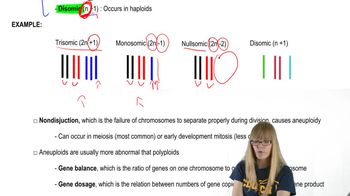
Understand the concept of aneuploidy: Aneuploidy refers to the presence of an abnormal number of chromosomes in a cell. In humans, this often results from errors during meiosis, leading to gametes with missing or extra chromosomes.
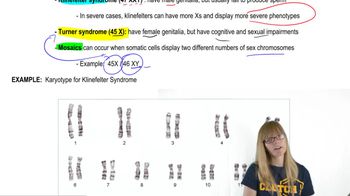
Recognize the role of karyotyping: Karyotyping is a laboratory technique that allows scientists to visualize the number and structure of chromosomes in a cell. It is used to detect aneuploidies in embryos, fetuses, and newborns.
Consider the evidence from spontaneous abortions: Studies have shown that a significant proportion of spontaneous abortions (miscarriages) are due to chromosomal abnormalities, with aneuploidy being the most common cause. This suggests that many aneuploid conceptions are not viable.
Examine the frequency of aneuploidy in live births: While aneuploidy is common at conception, only a few types of aneuploidy (such as Down syndrome, Turner syndrome, and Klinefelter syndrome) are compatible with life and result in live births. This indicates that most aneuploid embryos do not survive to term.
Review preimplantation genetic screening (PGS) data: PGS is used in assisted reproductive technologies to screen embryos for chromosomal abnormalities before implantation. High rates of aneuploidy are often detected in embryos, supporting the idea that aneuploid conceptions are frequent but usually inviable.

Verified video answer for a similar problem:

This video solution was recommended by our tutors as helpful for the problem above.
Video duration:
1m
Was this helpful?

Key Concepts

Here are the essential concepts you must grasp in order to answer the question correctly.

Aneuploidy

Aneuploidy refers to the presence of an abnormal number of chromosomes in a cell. In humans, this condition can arise from errors during meiosis, leading to gametes with extra or missing chromosomes. Common examples include Down syndrome (trisomy 21) and Turner syndrome (monosomy X). While aneuploidy can occur at conception, many aneuploid embryos fail to develop properly.
Recommended video:

Karyotype

A karyotype is a visual representation of an individual's complete set of chromosomes, organized by size and shape. It is used to identify chromosomal abnormalities, such as aneuploidy. Karyotyping can reveal the number of chromosomes and any structural changes, providing crucial information about genetic disorders and their potential viability.
Recommended video:
Guided course
10:35
Human Sex Chromosomes

Embryonic Viability

Embryonic viability refers to the ability of an embryo to develop into a healthy fetus and ultimately a live birth. Many aneuploid embryos are inviable due to the severe genetic imbalances they present, which disrupt normal development. Research indicates that a significant proportion of conceptions with aneuploid karyotypes result in early pregnancy loss, highlighting the critical role of chromosomal integrity in successful gestation.
Recommended video:
Guided course
03:46
Drosophilia Development