Pearson+ LogoPearson+ Logo
Ch. 8 - Chromosome Mutations: Variation in Number and Arrangement
Klug - Concepts of Genetics  12th Edition
Klug12th EditionConcepts of Genetics ISBN: 9780135564776Not the one you use?Change textbook
Chapter 8, Problem 4

For a species with a diploid number of 18, indicate how many chromosomes will be present in the somatic nuclei of individuals that are haploid, tetraploid, trisomic, and monosomic.

Verified step by step guidance
1
Identify the diploid number (2n) of the species, which is given as 18. This means the normal somatic cells have 18 chromosomes arranged in pairs.
Calculate the haploid number (n), which is half of the diploid number. Use the formula: \(n = \frac{2n}{2}\).
Determine the chromosome number in haploid individuals, which is simply the haploid number \(n\).
Calculate the chromosome number in tetraploid individuals, which have four sets of chromosomes. Use the formula: \$4n$.
For trisomic and monosomic individuals, start with the diploid number and then add or subtract one chromosome respectively. Use the formulas: trisomic = \$2n + 1\( and monosomic = \)2n - 1$.

Verified video answer for a similar problem:

This video solution was recommended by our tutors as helpful for the problem above.
Video duration:
2m
Was this helpful?

Key Concepts

Here are the essential concepts you must grasp in order to answer the question correctly.

Diploid Number and Ploidy Levels

The diploid number (2n) represents the total chromosomes in somatic cells, with two sets from each parent. Haploid cells (n) have half this number, while polyploid cells like tetraploids have multiple sets (e.g., 4n). Understanding ploidy helps determine chromosome counts in different cell types.
Recommended video:
Guided course
27:36
Diploid Genetics

Aneuploidy: Trisomy and Monosomy

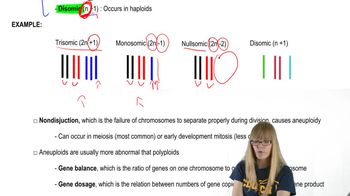
Aneuploidy refers to the presence of an abnormal number of chromosomes. Trisomy means having one extra chromosome (2n + 1), while monosomy means missing one chromosome (2n - 1). These conditions alter chromosome counts from the normal diploid number.
Recommended video:

Chromosome Counting in Somatic Cells

Somatic cells contain the full chromosome complement based on ploidy and aneuploidy status. Calculating chromosome numbers involves applying the ploidy level or aneuploid condition to the diploid number, enabling determination of chromosome counts in various genetic scenarios.
Recommended video:
Guided course
03:52
Cell-cell interactions