Pearson+ LogoPearson+ Logo
Ch. 1 - The Molecular Basis of Heredity, Variation, and Evolution
Sanders - Genetic Analysis: An Integrated Approach 3rd Edition
Sanders3rd EditionGenetic Analysis: An Integrated ApproachISBN: 9780135564172Not the one you use?Change textbook
Chapter 1, Problem 14b

Briefly describe the contribution each of the following people made to the development of genetics or genetic analysis.
Rosalind Franklin:

Verified step by step guidance
1
Rosalind Franklin was a pioneering scientist whose work in X-ray crystallography was critical to understanding the structure of DNA.
She captured high-resolution X-ray diffraction images of DNA, including the famous 'Photo 51,' which revealed the helical structure of DNA.
Her data provided key evidence that DNA is a double helix, with the sugar-phosphate backbone on the outside and the nitrogenous bases on the inside.
Franklin's meticulous experimental techniques and analysis laid the groundwork for Watson and Crick's model of DNA, although her contributions were not fully recognized during her lifetime.
Her work also extended to RNA and viruses, demonstrating her broad impact on molecular biology and genetics.

Verified video answer for a similar problem:

This video solution was recommended by our tutors as helpful for the problem above.
Video duration:
1m
Was this helpful?

Key Concepts

Here are the essential concepts you must grasp in order to answer the question correctly.

DNA Structure

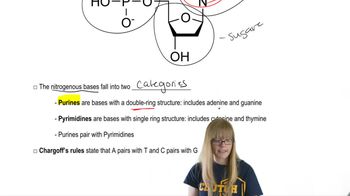
Rosalind Franklin is best known for her work on the structure of DNA, particularly through her use of X-ray diffraction techniques. Her famous Photo 51 provided critical evidence of the helical structure of DNA, which was pivotal in understanding how genetic information is stored and transmitted. This foundational knowledge laid the groundwork for the later discovery of the double helix model by Watson and Crick.
Recommended video:
Guided course
06:25
DNA Structure

X-ray Crystallography

X-ray crystallography is a technique used to determine the atomic and molecular structure of a crystal by diffracting X-ray beams through it. Franklin's expertise in this method allowed her to produce high-resolution images of DNA, revealing its dimensions and helical nature. This technique is essential in genetics for visualizing complex biological molecules and understanding their functions.
Recommended video:
Guided course
09:30
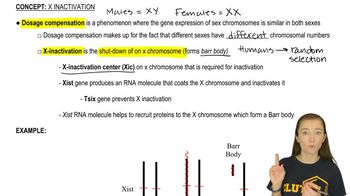
X-Inactivation

Scientific Collaboration and Recognition

Franklin's contributions to genetics were initially underappreciated, highlighting the importance of collaboration and recognition in scientific research. Her data was used without her direct consent by Watson and Crick, which raises discussions about ethics in science. Understanding the dynamics of scientific collaboration is crucial for recognizing the contributions of all researchers in the field of genetics.
Recommended video:
Guided course
05:19
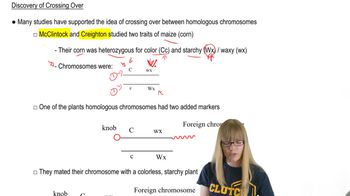
Discovery of Crossing Over