Pearson+ LogoPearson+ Logo
Ch. 5 - Genetic Linkage and Mapping in Eukaryotes
Sanders - Genetic Analysis: An Integrated Approach 3rd Edition
Sanders3rd EditionGenetic Analysis: An Integrated ApproachISBN: 9780135564172Not the one you use?Change textbook
Chapter 5, Problem 24d

The boss in your laboratory has just heard of a proposal by another laboratory that genes for eye color and the length of body bristles may be linked in Drosophila. Your lab has numerous pure-breeding stocks of Drosophila that could be used to verify or refute genetic linkage. In Drosophila, red eyes (c⁺) are dominant to brown eyes (c) and long bristles (d⁺) are dominant to short bristles (d). Your lab boss asks you to design an experiment to test the genetic linkage of eye color and bristle-length genes, and to begin by crossing a pure-breeding line homozygous for red eyes and short bristles to a pure-breeding line that has brown eyes and long bristles.


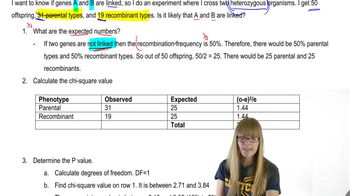
How would the results of the cross differ if the genes are not linked?

Verified step by step guidance
1
Step 1: Begin by understanding the genetic setup. The pure-breeding line with red eyes and short bristles has the genotype c⁺c⁺d⁺d⁺, while the pure-breeding line with brown eyes and long bristles has the genotype ccdd. These genotypes are homozygous for their respective traits.
Step 2: Perform the initial cross between the two pure-breeding lines. The offspring (F₁ generation) will inherit one allele from each parent. Since red eyes (c⁺) and long bristles (d⁺) are dominant, all F₁ individuals will have the genotype c⁺cd⁺d and display the dominant phenotypes: red eyes and long bristles.
Step 3: To test for genetic linkage, perform a test cross. Mate the F₁ individuals (c⁺cd⁺d) with a homozygous recessive individual (ccdd). This will allow you to observe the segregation of alleles in the offspring (F₂ generation).
Step 4: If the genes are not linked, the alleles for eye color and bristle length will assort independently according to Mendel's law of independent assortment. This means the F₂ generation will display a phenotypic ratio of 1:1:1:1, corresponding to the combinations: red eyes with long bristles, red eyes with short bristles, brown eyes with long bristles, and brown eyes with short bristles.
Step 5: Analyze the phenotypic ratios of the F₂ generation. If the observed ratios deviate significantly from the expected 1:1:1:1 ratio, it suggests that the genes for eye color and bristle length may be linked. If the ratios match the expected 1:1:1:1, the genes are likely not linked.

Verified video answer for a similar problem:

This video solution was recommended by our tutors as helpful for the problem above.
Video duration:
2m
Was this helpful?

Key Concepts

Here are the essential concepts you must grasp in order to answer the question correctly.

Genetic Linkage

Genetic linkage refers to the tendency of genes located close to each other on the same chromosome to be inherited together during meiosis. When genes are linked, the assortment of alleles does not follow Mendel's law of independent assortment, leading to a higher frequency of parental combinations in the offspring. Understanding linkage is crucial for predicting the outcomes of genetic crosses and interpreting the results.
Recommended video:
Guided course
07:33
Chi Square and Linkage

Mendelian Inheritance

Mendelian inheritance is the set of principles that describe how traits are passed from parents to offspring through alleles. It includes concepts such as dominance, segregation, and independent assortment. In the context of the experiment, if the genes for eye color and bristle length are not linked, the offspring will exhibit a phenotypic ratio consistent with Mendelian predictions, specifically a 9:3:3:1 ratio in a dihybrid cross.
Recommended video:
Guided course
05:13
Organelle Inheritance

Phenotypic Ratios

Phenotypic ratios represent the relative frequencies of different phenotypes in the offspring resulting from a genetic cross. In a typical dihybrid cross involving two traits, if the genes are unlinked, the expected phenotypic ratio is 9:3:3:1. This ratio helps in determining whether the observed results align with Mendelian expectations, thus indicating whether the genes are linked or assort independently.
Recommended video:
Guided course
10:48
Mutations and Phenotypes
Related Practice
Textbook Question

The boss in your laboratory has just heard of a proposal by another laboratory that genes for eye color and the length of body bristles may be linked in Drosophila. Your lab has numerous pure-breeding stocks of Drosophila that could be used to verify or refute genetic linkage. In Drosophila, red eyes (c⁺) are dominant to brown eyes (c) and long bristles (d⁺) are dominant to short bristles (d). Your lab boss asks you to design an experiment to test the genetic linkage of eye color and bristle-length genes, and to begin by crossing a pure-breeding line homozygous for red eyes and short bristles to a pure-breeding line that has brown eyes and long bristles.


Give the genotypes of the pure-breeding parental flies and the genotype(s) and phenotype(s) of the F₁ progeny they produce.

380
views
Textbook Question

The boss in your laboratory has just heard of a proposal by another laboratory that genes for eye color and the length of body bristles may be linked in Drosophila. Your lab has numerous pure-breeding stocks of Drosophila that could be used to verify or refute genetic linkage. In Drosophila, red eyes (c⁺) are dominant to brown eyes (c) and long bristles (d⁺) are dominant to short bristles (d). Your lab boss asks you to design an experiment to test the genetic linkage of eye color and bristle-length genes, and to begin by crossing a pure-breeding line homozygous for red eyes and short bristles to a pure-breeding line that has brown eyes and long bristles.


In your experimental design, what are the genotype and phenotype of the line you propose to cross to the F₁ to obtain the most useful information about genetic linkage between the eye color and bristle-length genes? Explain why you make this choice.

463
views
Textbook Question

The boss in your laboratory has just heard of a proposal by another laboratory that genes for eye color and the length of body bristles may be linked in Drosophila. Your lab has numerous pure-breeding stocks of Drosophila that could be used to verify or refute genetic linkage. In Drosophila, red eyes (c⁺) are dominant to brown eyes (c) and long bristles (d⁺) are dominant to short bristles (d). Your lab boss asks you to design an experiment to test the genetic linkage of eye color and bristle-length genes, and to begin by crossing a pure-breeding line homozygous for red eyes and short bristles to a pure-breeding line that has brown eyes and long bristles.


Assume the eye color and bristle-length genes are separated by 28 m.u. What are the approximate frequencies of phenotypes expected from the cross you proposed in part (b)?

459
views
Textbook Question

In rabbits, chocolate-colored fur (w⁺) is dominant to white fur (w), straight fur (c⁺) is dominant to curly fur (c), and long ear (s⁺) is dominant to short ear (s). The cross of a trihybrid rabbit with straight, chocolate-colored fur and long ears to a rabbit that has white, curly fur and short ears produces the following results:

Determine the order of the genes on the chromosome, and identify the alleles that are present on each of the homologous chromosomes in the trihybrid rabbits.

447
views
Textbook Question

In rabbits, chocolate-colored fur (w⁺) is dominant to white fur (w), straight fur (c⁺) is dominant to curly fur (c), and long ear (s⁺) is dominant to short ear (s). The cross of a trihybrid rabbit with straight, chocolate-colored fur and long ears to a rabbit that has white, curly fur and short ears produces the following results:

Calculate the recombination frequencies between each of the adjacent pairs of genes.

499
views
Textbook Question

In rabbits, chocolate-colored fur (w⁺) is dominant to white fur (w), straight fur (c⁺) is dominant to curly fur (c), and long ear (s⁺) is dominant to short ear (s). The cross of a trihybrid rabbit with straight, chocolate-colored fur and long ears to a rabbit that has white, curly fur and short ears produces the following results:

Determine the interference value for this cross.

402
views