Pearson+ LogoPearson+ Logo
Ch. 7 - DNA Structure and Replication
Sanders - Genetic Analysis: An Integrated Approach 3rd Edition
Sanders3rd EditionGenetic Analysis: An Integrated ApproachISBN: 9780135564172Not the one you use?Change textbook
Chapter 7, Problem 5h

One strand of a fragment of duplex DNA has the sequence 5'-ATCGACCTGATC-3'.
What term is used to describe the pattern of base pairing between one DNA strand and its partner in a duplex?

Verified step by step guidance
1
The term used to describe the pattern of base pairing between one DNA strand and its partner in a duplex is 'complementary base pairing.' This refers to the specific pairing of nitrogenous bases in DNA.
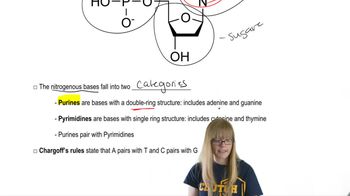
In DNA, adenine (A) pairs with thymine (T) through two hydrogen bonds, and cytosine (C) pairs with guanine (G) through three hydrogen bonds. This ensures the strands are complementary to each other.
To determine the complementary strand for the given sequence, write the sequence of the original strand: 5'-ATCGACCTGATC-3'.
Next, replace each base with its complementary base: A with T, T with A, C with G, and G with C. This will give the complementary sequence.
Finally, reverse the direction of the complementary sequence to ensure it is written in the 5' to 3' direction, as DNA strands are antiparallel. This means the complementary strand will be written as 3'-TAGCTGGACTAG-5'.

Verified video answer for a similar problem:

This video solution was recommended by our tutors as helpful for the problem above.
Video duration:
57s
Was this helpful?

Key Concepts

Here are the essential concepts you must grasp in order to answer the question correctly.

Base Pairing

Base pairing refers to the specific hydrogen bonding between nitrogenous bases in DNA. In a duplex DNA structure, adenine (A) pairs with thymine (T) through two hydrogen bonds, while cytosine (C) pairs with guanine (G) through three hydrogen bonds. This complementary pairing is crucial for the stability of the DNA double helix and ensures accurate replication and transcription.
Recommended video:
Guided course
03:49
Base Distortions

Antiparallel Orientation

DNA strands are oriented in an antiparallel fashion, meaning that one strand runs in the 5' to 3' direction while the complementary strand runs in the 3' to 5' direction. This orientation is essential for the proper alignment of base pairs and is critical during DNA replication and transcription, as enzymes that synthesize DNA and RNA can only add nucleotides to the 3' end of a growing strand.
Recommended video:

Duplex DNA Structure

Duplex DNA structure refers to the double helical formation of DNA, consisting of two intertwined strands held together by base pairs. This structure was famously described by Watson and Crick and is fundamental to the storage of genetic information. The stability and integrity of the duplex are vital for cellular processes such as replication, repair, and gene expression.
Recommended video:
Guided course
06:25
DNA Structure