
Textbook Question
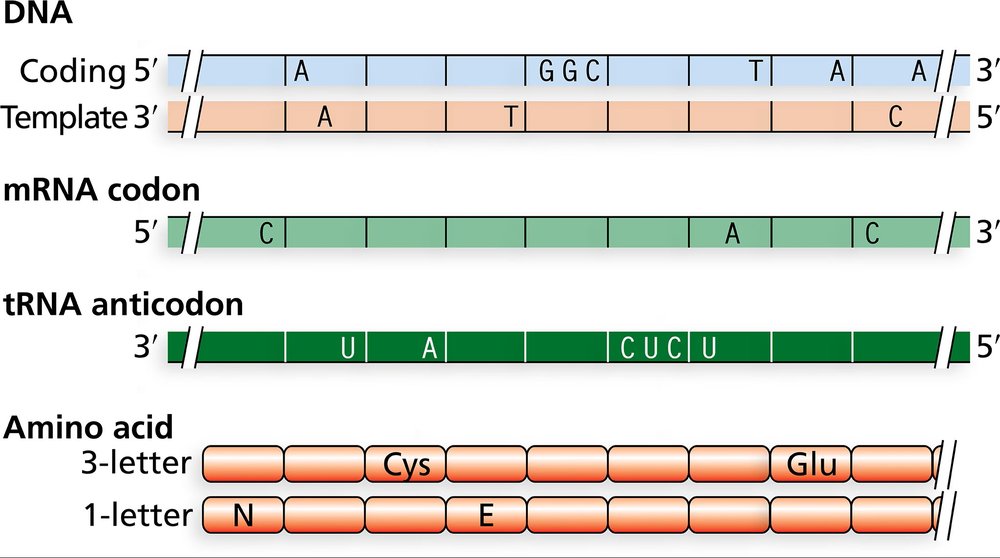
The three major forms of RNA (mRNA, tRNA, and rRNA) interact during translation.
Compared to the average stability of mRNA in E. coli, is mRNA in a typical human cell more stable or less stable? Why?
831
views

 Verified step by step guidance

 09:03
09:03
 05:13
05:13 18:27
18:27The three major forms of RNA (mRNA, tRNA, and rRNA) interact during translation.
Compared to the average stability of mRNA in E. coli, is mRNA in a typical human cell more stable or less stable? Why?
After completing Problem 17, carefully draw a line below the mRNA to represent its polypeptide product in accurate alignment with the mRNA. Label the N-terminal and C-terminal ends of the polypeptide. Carefully draw two lines above and parallel to the mRNA, and label them 'coding strand' and 'template strand.' Locate the DNA promoter sequence. Identify the locations of the nucleotide and of a transcription termination sequence.
The line below represents a mature eukaryotic mRNA. The accompanying list contains many sequences or structures that are part of eukaryotic mRNA. A few of the items in the list, however, are not found in eukaryotic mRNA. As accurately as you can, show the location, on the line, of the sequences or structures that belong in eukaryotic mRNA; then, separately, list the items that are not part of eukaryotic mRNA.
5′ ____________________________ 3′
a. stop codon
b. poly-A tail
c. intron
d. 3' UTR
e. promoter
f. start codon
g. AAUAAA
h. 5' UTR
i. 5' cap
j. termination sequence
The three major forms of RNA (mRNA, tRNA, and rRNA) interact during translation.
Which of the three types of RNA might you expect to be the least stable? Why?
Define and describe the differences in the primary, secondary, and tertiary structures of a protein.
The three major forms of RNA (mRNA, tRNA, and rRNA) interact during translation.
Which form of RNA is least stable in eukaryotes? Why is this form least stable?