Write the abbreviation for each of the following units: c. kilometer
Verified step by step guidance
1
Step 1: Understand the concept of unit abbreviations. Units of measurement often have standardized abbreviations to simplify their representation. For example, 'meter' is abbreviated as 'm'.
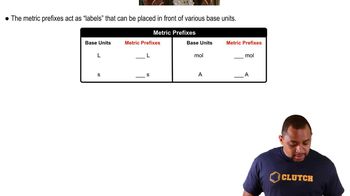
Step 2: Recall that the prefix 'kilo-' represents a factor of 10³ (or 1000). This prefix is commonly used in the metric system to denote larger quantities.
Step 3: Combine the prefix 'kilo-' with the base unit 'meter'. The abbreviation for 'meter' is 'm', and the prefix 'kilo-' is abbreviated as 'k'.
Step 4: Write the abbreviation for 'kilometer' by combining the prefix and the base unit. The result is 'km'.
Step 5: Confirm that 'km' is the correct abbreviation for 'kilometer' by referencing standard metric system conventions.
Verified video answer for a similar problem:
This video solution was recommended by our tutors as helpful for the problem above
Video duration:
2m
Play a video:
Was this helpful?
Key Concepts
Here are the essential concepts you must grasp in order to answer the question correctly.
Unit of Measurement
A unit of measurement is a standard quantity used to express a physical quantity. In the context of distance, units like kilometers, meters, and miles provide a way to quantify how far apart two points are. Understanding these units is essential for converting and comparing distances in various contexts.
An abbreviation is a shortened form of a word or phrase. In scientific and technical contexts, abbreviations are commonly used to simplify communication. For example, 'kilometer' is abbreviated as 'km', which allows for easier writing and reading in documents and discussions related to distance.
The metric system is an international decimalized system of measurement based on the meter, liter, and gram as units of length, volume, and mass, respectively. It is widely used around the world for scientific and everyday measurements. The kilometer, as a unit of length in the metric system, is equal to 1,000 meters, making it a fundamental concept in understanding distances.