Pearson+ LogoPearson+ Logo
Ch.2 Chemistry and Measurements
Timberlake - Chemistry: An Introduction to General, Organic, and Biological Chemistry 13th Edition
Timberlake13th EditionChemistry: An Introduction to General, Organic, and Biological ChemistryISBN: 9780134421353Not the one you use?Change textbook
Chapter 2, Problem 33c

Write the complete name for each of the following units:
c. ms

Verified step by step guidance
1
Step 1: Recognize that 'ms' is a unit of time measurement in the metric system.
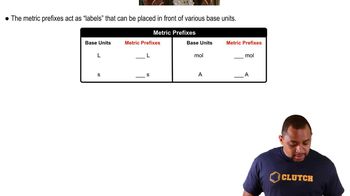
Step 2: Break down the unit 'ms' into its components: 'm' stands for 'milli-' and 's' stands for 'seconds'.
Step 3: Recall that the prefix 'milli-' in the metric system represents a factor of 10-3, or 1/1000.
Step 4: Combine the prefix and the base unit to form the complete name. 'ms' stands for 'milliseconds', which means 1/1000 of a second.
Step 5: Verify the interpretation by considering the context of the metric system and ensuring the prefix and base unit are correctly matched.

Verified video answer for a similar problem:

This video solution was recommended by our tutors as helpful for the problem above.
Video duration:
1m
Was this helpful?

Key Concepts

Here are the essential concepts you must grasp in order to answer the question correctly.

Millisecond

A millisecond (ms) is a unit of time equal to one thousandth of a second. It is commonly used in various fields such as computing, music, and physics to measure short durations. For example, in digital audio, the timing of sound samples is often measured in milliseconds.

Metric System

The metric system is an international decimalized system of measurement that includes units such as meters, liters, and grams. It is based on powers of ten, making it easier to convert between units. The millisecond is part of this system, which standardizes measurements across different scientific and technical disciplines.
Recommended video:
Guided course
01:16
Metric Prefixes

Time Measurement

Time measurement is the process of quantifying the duration of events or the intervals between them. It is fundamental in various applications, from scientific experiments to everyday activities. Understanding units like milliseconds is crucial for precision in fields such as engineering, telecommunications, and computer science.
Recommended video:
Guided course
02:52
Measuring Radioactivity Concept 1