Pearson+ LogoPearson+ Logo
Ch.13 Carbohydrates
Timberlake - Chemistry: An Introduction to General, Organic, and Biological Chemistry 13th Edition
Timberlake13th EditionChemistry: An Introduction to General, Organic, and Biological ChemistryISBN: 9780134421353Not the one you use?Change textbook
Chapter 13, Problem 5

What functional groups are found in all monosaccharides?

Verified step by step guidance
1
Understand that monosaccharides are the simplest form of carbohydrates and are composed of carbon, hydrogen, and oxygen atoms in a specific ratio.
Recall that all monosaccharides contain two key functional groups: a carbonyl group (C=O) and multiple hydroxyl groups (-OH).
Identify the carbonyl group, which can be either an aldehyde (if the carbonyl group is at the end of the carbon chain) or a ketone (if the carbonyl group is within the carbon chain). This distinction classifies monosaccharides as aldoses or ketoses, respectively.
Recognize that the hydroxyl groups (-OH) are attached to the other carbon atoms in the monosaccharide, making the molecule highly polar and hydrophilic.
Conclude that the presence of both the carbonyl group and hydroxyl groups is a defining characteristic of all monosaccharides, regardless of their specific structure or classification.

Verified video answer for a similar problem:

This video solution was recommended by our tutors as helpful for the problem above.
Video duration:
3m
Was this helpful?

Key Concepts

Here are the essential concepts you must grasp in order to answer the question correctly.

Monosaccharides

Monosaccharides are the simplest form of carbohydrates, consisting of single sugar molecules. They serve as the building blocks for more complex carbohydrates and are characterized by their sweet taste and solubility in water. Common examples include glucose, fructose, and galactose, each with distinct structural formulas.
Recommended video:
Guided course
0:55
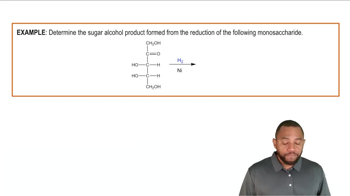
Reduction of Monosaccharides Example 1

Functional Groups

Functional groups are specific groups of atoms within molecules that are responsible for the characteristic chemical reactions of those molecules. In the context of monosaccharides, the most common functional groups are hydroxyl (-OH) groups and carbonyl (C=O) groups, which play a crucial role in their reactivity and properties.
Recommended video:
Guided course
1:11
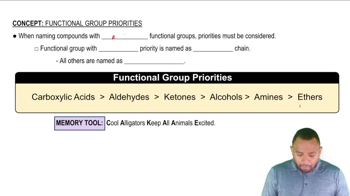
Functional Group Priorities Concept 1

Hydroxyl and Carbonyl Groups

Hydroxyl groups are polar and can form hydrogen bonds, making monosaccharides soluble in water. Carbonyl groups, found in either aldehyde or ketone forms, are essential for the classification of monosaccharides. The presence of these functional groups is what allows monosaccharides to participate in various biochemical reactions, including forming glycosidic bonds.
Recommended video:
Guided course
1:00
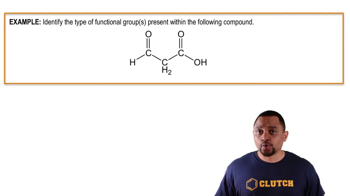
Functional Groups with Carbonyls Example 3