Write each of the following in scientific notation with two significant figures: c. 100 000 m
Verified step by step guidance
1
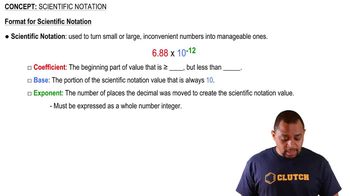
Step 1: Understand the concept of scientific notation. Scientific notation expresses numbers as a product of a coefficient (between 1 and 10) and a power of 10. For example, a number like 100,000 can be written as \( 1.0 \times 10^5 \).
Step 2: Identify the significant figures. The problem specifies that the number should be written with two significant figures. In this case, the first two significant figures of 100,000 are '1' and '0'.
Step 3: Rewrite the number in scientific notation. To do this, move the decimal point in the number 100,000 to the left until only one non-zero digit remains to the left of the decimal point. This gives \( 1.0 \).
Step 4: Count how many places the decimal point was moved. In this case, the decimal point was moved 5 places to the left, so the power of 10 is \( 10^5 \).
Step 5: Combine the coefficient and the power of 10. The final expression in scientific notation with two significant figures is \( 1.0 \times 10^5 \).
Verified video answer for a similar problem:
This video solution was recommended by our tutors as helpful for the problem above
Video duration:
1m
Play a video:
Was this helpful?
Key Concepts
Here are the essential concepts you must grasp in order to answer the question correctly.
Scientific Notation
Scientific notation is a method of expressing numbers that are too large or too small in a compact form. It is written as the product of a number between 1 and 10 and a power of ten. For example, the number 100,000 can be expressed as 1.0 x 10^5 in scientific notation.
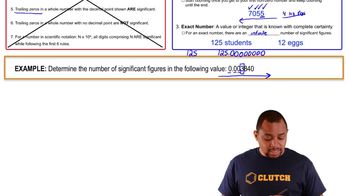
Significant figures are the digits in a number that contribute to its precision. This includes all non-zero digits, any zeros between significant digits, and trailing zeros only if there is a decimal point. When converting to scientific notation, it is important to round the number to the specified number of significant figures, which in this case is two.
Rounding rules dictate how to adjust numbers to the desired level of precision. When rounding to two significant figures, if the digit following the last significant figure is 5 or greater, the last significant figure is increased by one. This ensures that the representation of the number remains as accurate as possible while adhering to the specified significant figure requirement.