Pearson+ LogoPearson+ Logo
Ch.10 Acids and Bases and Equilibrium
Timberlake - Chemistry: An Introduction to General, Organic, and Biological Chemistry 13th Edition
Timberlake13th EditionChemistry: An Introduction to General, Organic, and Biological ChemistryISBN: 9780134421353Not the one you use?Change textbook
Chapter 10, Problem 39f

Calculate the pH of each solution given the following:
f. [OH-] = 8.2 × 10⁻⁴ M

Verified step by step guidance
1
Step 1: Recall the relationship between pH, pOH, and the concentration of hydroxide ions ([OH⁻]). The formula to calculate pOH is: pOH=-log([OH]-).
Step 2: Substitute the given [OH⁻] value (8.2 × 10⁻⁴ M) into the formula for pOH. This will give you the pOH of the solution.
Step 3: Use the relationship between pH and pOH, which is: pH=14-pOH. Subtract the calculated pOH from 14 to find the pH.
Step 4: Ensure that your final pH value is reasonable. For a solution with a relatively high [OH⁻], the pH should be greater than 7, indicating a basic solution.
Step 5: Double-check your calculations for accuracy, especially when using logarithms and subtraction, to ensure the correct pH value is obtained.

Verified video answer for a similar problem:

This video solution was recommended by our tutors as helpful for the problem above.
Video duration:
2m
Was this helpful?

Key Concepts

Here are the essential concepts you must grasp in order to answer the question correctly.

pH Scale

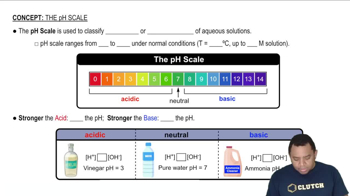
The pH scale measures the acidity or basicity of a solution, ranging from 0 to 14. A pH of 7 is considered neutral, while values below 7 indicate acidity and values above 7 indicate alkalinity. The scale is logarithmic, meaning each whole number change represents a tenfold change in hydrogen ion concentration.
Recommended video:

Hydroxide Ion Concentration

Hydroxide ions (OH⁻) are negatively charged ions that play a crucial role in determining the basicity of a solution. The concentration of hydroxide ions can be used to calculate the pOH of a solution, which is related to pH through the equation pH + pOH = 14. Understanding the concentration of OH⁻ is essential for calculating the corresponding pH.
Recommended video:
Guided course
00:52
Percent Concentrations Concept 1

Relationship Between pH and pOH

The relationship between pH and pOH is defined by the equation pH + pOH = 14 at 25°C. This means that if you know the pOH of a solution, you can easily find its pH by subtracting the pOH from 14. This relationship is fundamental in acid-base chemistry and is crucial for solving problems involving pH calculations.
Recommended video:
Guided course
00:48
Least Acidic Solution Example