Pearson+ LogoPearson+ Logo
Ch.17 Nucleic Acids and Protein Synthesis
Timberlake - Chemistry: An Introduction to General, Organic, and Biological Chemistry 13th Edition
Timberlake13th EditionChemistry: An Introduction to General, Organic, and Biological ChemistryISBN: 9780134421353Not the one you use?Change textbook
Chapter 17, Problem 89a

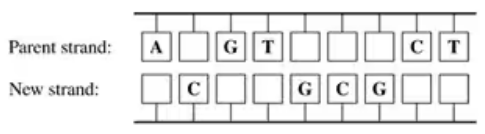
Answer the following questions for the given section of DNA:
a. Complete the bases in the parent and new strands.

Verified step by step guidance
1
Step 1: Understand the structure of DNA. DNA is a double-stranded molecule where each strand is composed of nucleotides. Each nucleotide consists of a sugar, a phosphate group, and a nitrogenous base. The bases pair specifically: adenine (A) pairs with thymine (T), and cytosine (C) pairs with guanine (G).
Step 2: Analyze the given DNA sequence. If the parent strand is provided, identify the sequence of bases on this strand. For example, if the parent strand has a sequence like A-T-G-C, note that these bases are complementary to the new strand.
Step 3: Apply base-pairing rules to complete the new strand. For each base in the parent strand, write the complementary base in the new strand. For example, if the parent strand has A, the new strand will have T; if the parent strand has G, the new strand will have C.
Step 4: If the image contains partial sequences, complete the missing bases in both the parent and new strands by following the base-pairing rules. Ensure that each base in the parent strand has a corresponding complementary base in the new strand.
Step 5: Double-check your work to ensure that all base pairs are correctly matched and that the DNA strands are antiparallel (one strand runs 5' to 3', and the other runs 3' to 5').

Verified video answer for a similar problem:

This video solution was recommended by our tutors as helpful for the problem above.
Video duration:
2m
Was this helpful?

Key Concepts

Here are the essential concepts you must grasp in order to answer the question correctly.

DNA Structure

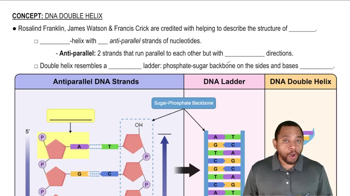
DNA is composed of two strands forming a double helix, with each strand made up of nucleotides. Each nucleotide consists of a sugar, a phosphate group, and a nitrogenous base (adenine, thymine, cytosine, or guanine). The bases pair specifically: adenine with thymine and cytosine with guanine, which is crucial for DNA replication and transcription.
Recommended video:
Guided course
3:27
DNA Double Helix Concept 1

Base Pairing Rules

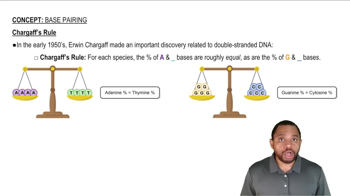
Base pairing rules dictate how nucleotides pair in DNA. Adenine (A) pairs with thymine (T), and cytosine (C) pairs with guanine (G). Understanding these rules is essential for completing the bases in both the parent and new strands of DNA, as they ensure accurate replication and maintain genetic fidelity.
Recommended video:
Guided course
2:01
Base Pairing Concept 2

DNA Replication

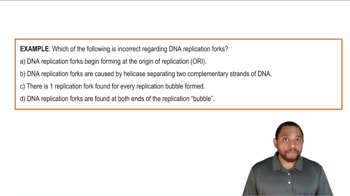
DNA replication is the process by which a cell duplicates its DNA before cell division. It involves unwinding the double helix and synthesizing new strands complementary to the original strands, following the base pairing rules. This process is vital for genetic continuity and is facilitated by enzymes such as DNA polymerase.
Recommended video:
Guided course
1:40
Intro to DNA Replication Example 2