Pearson+ LogoPearson+ Logo
Ch.4 Atoms and Elements
Timberlake - Chemistry: An Introduction to General, Organic, and Biological Chemistry 13th Edition
Timberlake13th EditionChemistry: An Introduction to General, Organic, and Biological ChemistryISBN: 9780134421353Not the one you use?Change textbook
Chapter 4, Problem 37d

Argon has three naturally occurring isotopes, with mass numbers 36, 38, and 40.
d. Why is the atomic mass of argon listed on the periodic table not a whole number?

Verified step by step guidance
1
The atomic mass of an element listed on the periodic table is a weighted average of the masses of all its naturally occurring isotopes, not the mass of a single isotope.
Each isotope of argon has a different mass number (36, 38, and 40), which corresponds to the total number of protons and neutrons in its nucleus.
The relative abundance of each isotope in nature determines how much it contributes to the weighted average. For example, if one isotope is more abundant, it will have a greater influence on the atomic mass.
The weighted average is calculated using the formula: Atomic Mass=i (Fractional Abundance × Isotopic Mass).
Since the isotopic masses and their relative abundances are not whole numbers, the resulting weighted average (atomic mass) is also not a whole number.

Verified video answer for a similar problem:

This video solution was recommended by our tutors as helpful for the problem above.
Video duration:
1m
Was this helpful?

Key Concepts

Here are the essential concepts you must grasp in order to answer the question correctly.

Isotopes

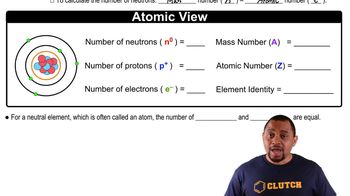
Isotopes are variants of a chemical element that have the same number of protons but different numbers of neutrons, resulting in different mass numbers. For argon, the isotopes with mass numbers 36, 38, and 40 represent the different forms of argon found in nature. Understanding isotopes is crucial for grasping why elements can have non-integer atomic masses.
Recommended video:

Atomic Mass

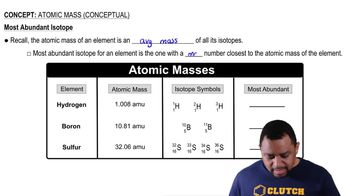
Atomic mass is the weighted average mass of an element's isotopes, measured in atomic mass units (amu). It reflects the relative abundance of each isotope in nature. For argon, the atomic mass is not a whole number because it accounts for the contributions of all its isotopes, weighted by their natural abundance.
Recommended video:
Guided course
02:49
Atomic Mass (Conceptual) Concept 2

Natural Abundance

Natural abundance refers to the relative proportions of each isotope of an element found in nature. For argon, the isotopes have different abundances, which affects the overall atomic mass. This concept is essential for understanding why the atomic mass listed on the periodic table is a decimal rather than a whole number.
Recommended video:
Guided course
01:26
Nature of Energy