Pearson+ LogoPearson+ Logo
Ch.4 Atoms and Elements
Timberlake - Chemistry: An Introduction to General, Organic, and Biological Chemistry 13th Edition
Timberlake13th EditionChemistry: An Introduction to General, Organic, and Biological ChemistryISBN: 9780134421353Not the one you use?Change textbook
Chapter 4, Problem 17a

Identify each of the following as describing either a proton, a neutron, or an electron:
a. has the smallest mass

Verified step by step guidance
1
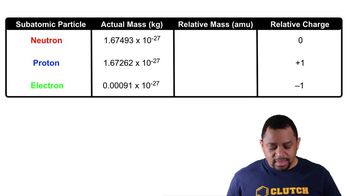
Step 1: Begin by recalling the relative masses of subatomic particles. A proton and a neutron have similar masses, approximately 1 atomic mass unit (amu), while an electron has a much smaller mass, approximately 1/1836 of the mass of a proton.
Step 2: Compare the masses of the three particles. Since the electron's mass is significantly smaller than that of a proton or neutron, it is the particle with the smallest mass.
Step 3: Understand the significance of this property. The small mass of the electron allows it to move rapidly around the nucleus, contributing to the atom's overall structure and chemical behavior.
Step 4: Confirm that the correct identification for the particle with the smallest mass is the electron.
Step 5: Review the concept of subatomic particles and their properties to reinforce understanding of their roles in atomic structure.

Verified video answer for a similar problem:

This video solution was recommended by our tutors as helpful for the problem above.
Video duration:
45s
Was this helpful?

Key Concepts

Here are the essential concepts you must grasp in order to answer the question correctly.

Proton

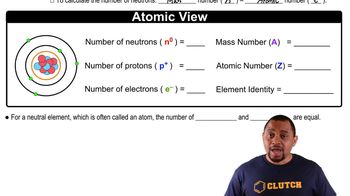
A proton is a positively charged subatomic particle found in the nucleus of an atom. It has a relative mass of approximately 1 atomic mass unit (amu) and plays a crucial role in determining the atomic number of an element, which defines its identity.
Recommended video:

Neutron

A neutron is a neutral subatomic particle also located in the nucleus of an atom. It has a mass similar to that of a proton, approximately 1 amu, and contributes to the atomic mass of an element, influencing its stability and isotopic composition.
Recommended video:
Guided course
02:36
Subatomic Particles (Simplified) Concept 2

Electron

An electron is a negatively charged subatomic particle that orbits the nucleus of an atom. It has a significantly smaller mass than protons and neutrons, approximately 1/1836 of an amu, and is essential for chemical bonding and the formation of molecules.
Recommended video:
Guided course
01:23
Electronic Structure: Electron Spin Concept 1