Pearson+ LogoPearson+ Logo
Ch.5 Nuclear Chemistry
Timberlake - Chemistry: An Introduction to General, Organic, and Biological Chemistry 13th Edition
Timberlake13th EditionChemistry: An Introduction to General, Organic, and Biological ChemistryISBN: 9780134421353Not the one you use?Change textbook
Chapter 5, Problem 19d

Complete each of the following nuclear equations and describe the type of radiation:
d. ? → 23490Th + 42He

Verified step by step guidance
1
Step 1: Understand the problem. The given nuclear equation involves a missing reactant that undergoes a nuclear reaction to produce thorium-234 (²³⁴₉₀Th) and a helium nucleus (⁴₂He). The helium nucleus is also known as an alpha particle, indicating that this is an alpha decay process.
Step 2: Recall the law of conservation of mass and atomic numbers. In a nuclear reaction, the sum of the mass numbers (superscripts) and the sum of the atomic numbers (subscripts) must be equal on both sides of the equation.
Step 3: Write the equation with placeholders for the missing reactant. Let the missing reactant be represented as ²³⁸₉₂X, where ²³⁸ is the mass number and ₉₂ is the atomic number. The equation becomes: ²³⁸₉₂X → ²³⁴₉₀Th + ⁴₂He.
Step 4: Verify the conservation of mass numbers. The mass number of the reactant (²³⁸) must equal the sum of the mass numbers of the products (²³⁴ + ⁴). This confirms that the mass number of the missing reactant is ²³⁸.
Step 5: Verify the conservation of atomic numbers. The atomic number of the reactant (₉₂) must equal the sum of the atomic numbers of the products (₉₀ + ₂). This confirms that the atomic number of the missing reactant is ₉₂, identifying it as uranium-238 (²³⁸₉₂U). The type of radiation is alpha radiation.

Verified video answer for a similar problem:

This video solution was recommended by our tutors as helpful for the problem above.
Video duration:
1m
Was this helpful?

Key Concepts

Here are the essential concepts you must grasp in order to answer the question correctly.

Nuclear Decay

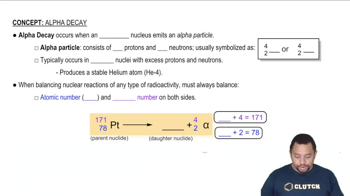
Nuclear decay is the process by which an unstable atomic nucleus loses energy by emitting radiation. This can occur in various forms, including alpha, beta, and gamma decay. In the context of the given equation, the decay process involves the transformation of one element into another, resulting in the emission of particles.
Recommended video:
Guided course
04:23
Alpha Decay Concept 1

Alpha Particle

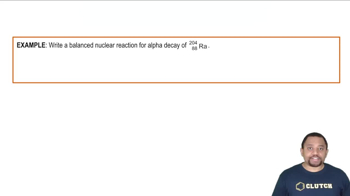
An alpha particle is a type of radiation consisting of two protons and two neutrons, essentially a helium nucleus. It is emitted during alpha decay, a common form of nuclear decay for heavy elements. The presence of an alpha particle in the equation indicates that the original nucleus is losing mass and charge, transforming into a new element.
Recommended video:
Guided course
01:33
Alpha Decay Concept 2

Balancing Nuclear Equations

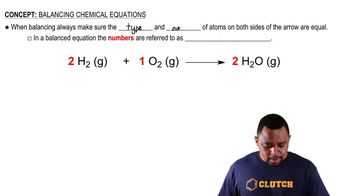
Balancing nuclear equations involves ensuring that the total number of protons and neutrons is conserved during a nuclear reaction. This means that the sum of the atomic numbers and mass numbers on both sides of the equation must be equal. In the provided equation, identifying the missing particle requires applying this principle to maintain balance.
Recommended video:
Guided course
01:32
Balancing Chemical Equations (Simplified) Concept 1