Pearson+ LogoPearson+ Logo
Ch.6 Ionic and Molecular Compounds
Timberlake - Chemistry: An Introduction to General, Organic, and Biological Chemistry 13th Edition
Timberlake13th EditionChemistry: An Introduction to General, Organic, and Biological ChemistryISBN: 9780134421353Not the one you use?Change textbook
Chapter 6, Problem 97d

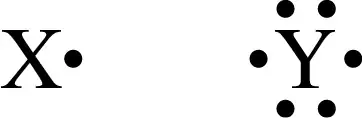
Consider the following Lewis symbols for elements X and Y:
Lewis dot symbols for elements X and Y, illustrating their valence electrons for ion formation analysis.
d. What would be the formula of a compound of X and Y?

Verified step by step guidance
1
Step 1: Identify the valence electrons for elements X and Y based on their Lewis symbols. The number of dots around the element symbol represents the number of valence electrons.
Step 2: Determine the number of electrons each element needs to achieve a full octet (8 valence electrons). For example, if X has 6 valence electrons, it needs 2 more electrons, and if Y has 1 valence electron, it needs to lose 1 electron to achieve a stable configuration.
Step 3: Analyze the ratio in which X and Y will combine to satisfy the octet rule for both elements. For instance, if X needs 2 electrons and Y can donate 1 electron, the ratio of X:Y would be 1:2.
Step 4: Write the chemical formula of the compound by combining X and Y in the ratio determined in the previous step. Use subscripts to indicate the number of each type of atom in the compound.
Step 5: Verify the formula by ensuring that the total number of electrons gained and lost by the elements results in a stable configuration for both X and Y.

Verified video answer for a similar problem:

This video solution was recommended by our tutors as helpful for the problem above.
Video duration:
1m
Was this helpful?

Key Concepts

Here are the essential concepts you must grasp in order to answer the question correctly.

Lewis Symbols

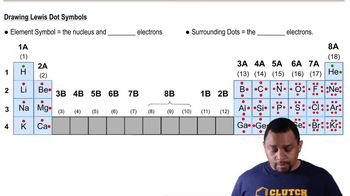
Lewis symbols are a way to represent the valence electrons of an atom using dots around the element's symbol. Each dot corresponds to a valence electron, which plays a crucial role in chemical bonding. Understanding Lewis symbols helps predict how atoms will interact and bond with each other to form compounds.
Recommended video:
Guided course
01:27
Lewis Dot Symbols (Simplified) Concept 2

Chemical Bonding

Chemical bonding refers to the forces that hold atoms together in a compound. The two primary types of bonds are ionic and covalent. Ionic bonds occur when electrons are transferred from one atom to another, while covalent bonds involve the sharing of electrons. The type of bond formed between elements X and Y will influence the compound's formula.
Recommended video:
Guided course
00:49
Chemical Reaction: Chemical Change Example 1

Empirical Formula

The empirical formula of a compound represents the simplest whole-number ratio of the elements present. It is derived from the number of atoms of each element in the compound. To determine the empirical formula of the compound formed by elements X and Y, one must consider their valence and the type of bond they form, which will dictate the ratio of X to Y in the compound.
Recommended video:
Guided course
02:26
Empirical Formula