Pearson+ LogoPearson+ Logo
Ch.7 Chemical Quantities and Reactions
Timberlake - Chemistry: An Introduction to General, Organic, and Biological Chemistry 13th Edition
Timberlake13th EditionChemistry: An Introduction to General, Organic, and Biological ChemistryISBN: 9780134421353Not the one you use?Change textbook
Chapter 7, Problem 1

What is a mole?

Verified step by step guidance
1
A mole is a fundamental concept in chemistry that represents a specific quantity of particles, such as atoms, molecules, or ions. It is used to bridge the microscopic world of atoms and molecules with the macroscopic world we can measure.
The mole is defined as the amount of substance that contains exactly 6.022 × 10^23 particles, known as Avogadro's number. This number is a constant and is used universally in chemistry.
To understand the mole, consider it as a 'chemist's dozen.' Just as a dozen represents 12 items, a mole represents 6.022 × 10^23 particles. This allows chemists to count and measure substances in practical quantities.
The mole is also connected to the concept of molar mass. The molar mass of a substance is the mass of one mole of that substance, expressed in grams per mole (g/mol). It is numerically equal to the atomic or molecular weight of the substance in atomic mass units (amu).
In practice, the mole is used to calculate quantities in chemical reactions, such as determining how many moles of reactants are needed or how many moles of products are formed. This makes it an essential tool for stoichiometry and quantitative chemistry.

Verified video answer for a similar problem:

This video solution was recommended by our tutors as helpful for the problem above.
Video duration:
1m
Was this helpful?

Key Concepts

Here are the essential concepts you must grasp in order to answer the question correctly.

Definition of a Mole

A mole is a fundamental unit in chemistry that quantifies the amount of substance. It is defined as the amount of substance that contains as many entities (atoms, molecules, ions, etc.) as there are in 12 grams of carbon-12. This number is known as Avogadro's number, approximately 6.022 x 10^23.
Recommended video:
Guided course
02:48
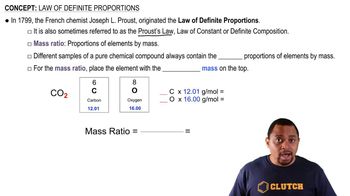
Law of Definite Proportions

Avogadro's Number

Avogadro's number is a constant that represents the number of particles in one mole of a substance. It is crucial for converting between the macroscopic scale of grams and the microscopic scale of individual atoms or molecules, allowing chemists to relate mass to the number of particles in a sample.
Recommended video:
Guided course
03:13
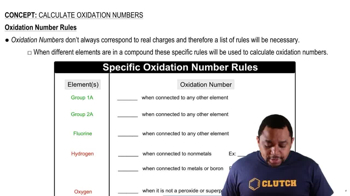
Calculate Oxidation Numbers

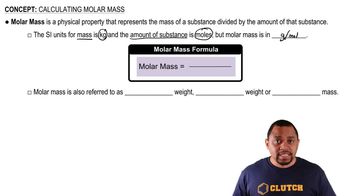
Molar Mass

Molar mass is the mass of one mole of a substance, typically expressed in grams per mole (g/mol). It is calculated by summing the atomic masses of all atoms in a molecule, providing a bridge between the mass of a substance and the number of moles, facilitating stoichiometric calculations in chemical reactions.
Recommended video:
Guided course
01:10
Calculating Molar Mass