Pearson+ LogoPearson+ Logo
Ch.9 Solutions
Timberlake - Chemistry: An Introduction to General, Organic, and Biological Chemistry 13th Edition
Timberlake13th EditionChemistry: An Introduction to General, Organic, and Biological ChemistryISBN: 9780134421353Not the one you use?Change textbook
Chapter 9, Problem 7

KF is a strong electrolyte, and HF is a weak electrolyte. How is the solution of KF different from that of HF?

Verified step by step guidance
1
Understand the concept of electrolytes: Strong electrolytes completely dissociate into ions in water, while weak electrolytes only partially dissociate. This difference affects the ion concentration in the solution.
Analyze KF (potassium fluoride): KF is a strong electrolyte, meaning it dissociates completely into K⁺ and F⁻ ions when dissolved in water. The solution will contain a high concentration of these ions.
Analyze HF (hydrofluoric acid): HF is a weak electrolyte, meaning it only partially dissociates into H⁺ and F⁻ ions in water. The solution will contain both undissociated HF molecules and a lower concentration of ions compared to KF.
Compare the ion concentrations: The KF solution will have a higher concentration of free ions (K⁺ and F⁻) compared to the HF solution, which will have fewer ions and more undissociated HF molecules.
Consider the pH and reactivity: HF, being a weak acid, contributes to the acidity of the solution, whereas KF, as a salt of a strong base and weak acid, does not significantly affect the pH. This difference impacts the chemical behavior of the solutions.

Verified video answer for a similar problem:

This video solution was recommended by our tutors as helpful for the problem above.
Video duration:
5m
Was this helpful?

Key Concepts

Here are the essential concepts you must grasp in order to answer the question correctly.

Strong Electrolytes

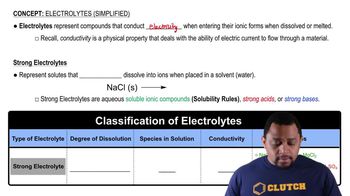
Strong electrolytes are substances that completely dissociate into ions when dissolved in water. This means that they produce a high concentration of ions in solution, which allows for efficient electrical conductivity. Examples include salts like potassium fluoride (KF), which fully ionizes into K+ and F- ions, leading to a solution that conducts electricity well.
Recommended video:
Guided course
02:38
Electrolytes (Simplified) Concept 1

Weak Electrolytes

Weak electrolytes are substances that only partially dissociate into ions in solution. This results in a lower concentration of ions compared to strong electrolytes, leading to reduced electrical conductivity. Hydrofluoric acid (HF) is an example, as it only partially ionizes, creating a mixture of undissociated HF molecules and a smaller amount of H+ and F- ions.
Recommended video:
Guided course
02:33
Electrolytes (Simplified) Concept 2

Conductivity in Solutions

The conductivity of a solution is determined by the presence and concentration of ions, which carry electric current. Strong electrolytes like KF produce a high number of ions, resulting in high conductivity, while weak electrolytes like HF produce fewer ions, leading to lower conductivity. This difference in ionization affects various properties of the solutions, including their ability to conduct electricity.
Recommended video: