Ch. 12 - Adaptive Immunity
Norman-McKay- Microbiology: Basic and Clinical Principles 2nd Edition
Norman-McKay2nd EditionMicrobiology: Basic and Clinical PrinciplesISBN: 9780137661619Not the one you use?Change textbook
Chapter 12, Problem 5

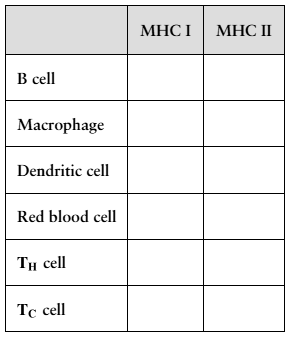
Complete the table to indicate which MHCs are present for each cell.
Table with cell types listed and empty columns for MHC I and MHC II presence to be completed.

Verified step by step guidance
1
Identify the types of cells listed in the table (e.g., nucleated cells, red blood cells, antigen-presenting cells) since MHC expression depends on cell type.
Recall that MHC class I molecules are expressed on almost all nucleated cells, so mark MHC I as present for these cells.
Remember that MHC class II molecules are primarily expressed on professional antigen-presenting cells such as dendritic cells, macrophages, and B cells; mark MHC II as present only for these cells.
Note that red blood cells (erythrocytes) do not have nuclei and typically do not express MHC molecules; mark both MHC I and MHC II as absent for these cells.
Complete the table by filling in 'present' or 'absent' for MHC I and MHC II for each cell type based on the above criteria.

Verified video answer for a similar problem:

This video solution was recommended by our tutors as helpful for the problem above.
Video duration:
1m
Was this helpful?

Key Concepts

Here are the essential concepts you must grasp in order to answer the question correctly.

Major Histocompatibility Complex (MHC) Classes

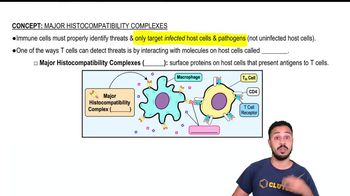
MHC molecules are cell surface proteins essential for immune recognition. Class I MHC molecules are present on almost all nucleated cells and present endogenous antigens to CD8+ T cells. Class II MHC molecules are primarily found on antigen-presenting cells and present exogenous antigens to CD4+ T cells.
Recommended video:
Guided course
02:31
Major Histocompatibility Complex Molecules

Cell Types and MHC Expression

Different cell types express distinct MHC classes based on their immune function. For example, all nucleated cells express MHC I, while professional antigen-presenting cells like dendritic cells, macrophages, and B cells express both MHC I and II. Understanding which cells express which MHC is key to completing the table.
Recommended video:
Guided course
06:40
Introduction to Regulation of Gene Expression

Role of MHC in Immune Response

MHC molecules present peptide antigens to T cells, initiating adaptive immune responses. MHC I presents peptides from intracellular pathogens to cytotoxic T cells, while MHC II presents extracellular pathogen peptides to helper T cells. This distinction is crucial for understanding immune cell interactions.
Recommended video:
Guided course
02:57
Intro to Immune Response Damage
Related Practice
Textbook Question

In which of the following scenarios would administering immunoglobulins be useful? Select all that apply.

a. To neutralize a toxin

b. To aid a patient who is immune compromised

c. After venom exposure

d. To block IgM from crossing the placenta

e. To protect a premature infant from respiratory syncytial virus

863
views
Textbook Question

Why are packed red blood cells not tissue typed? Select all that apply.

a. Red blood cells lack MHC II

b. Red blood cells lack MHC I

c. Red blood cells can’t stimulate an immune response

d. Red blood cells aren’t transferred to others

e. Red blood cells don’t make antibodies and therefore do not need to be typed

1224
views
Textbook Question

Indicate the true statements and correct the false statements so they are true.

a. B cells are activated by antigen-presenting cells

b. T cytotoxic cells are activated by antigens bound to MHC I

c. Upon activation, T helper cells stimulate T cytotoxic cells and B cells

d. IgG is the first antibody made during a primary response

e. T-dependent antigens rely on TH cells to activate B cells

1475
views
Textbook Question

Which of the following does not generate long-term immunological memory? Select all that apply.

a. Antivenom

b. Antitoxins

c. Vaccinations

d. Breast-feeding

e. Antigens

1115
views
Textbook Question

T helper cells activate B cells to become ________________, which make ________________.

1520
views
Textbook Question

In which of the following scenarios would administering immunoglobulins be useful? Select all that apply. (NCLEX/HESI/TEAS)

a. To neutralize a toxin

b. To aid a patient who is immune compromised

c. After venom exposure

d. To block IgM from crossing the placenta

e. To protect a premature infant from respiratory syncytial virus

1420
views