Back
Back
Problem 1
Indicate the true statements and correct the false statements so they are true.
a. B cells are activated by antigen-presenting cells
b. T cytotoxic cells are activated by antigens bound to MHC I
c. Upon activation, T helper cells stimulate T cytotoxic cells and B cells
d. IgG is the first antibody made during a primary response
e. T-dependent antigens rely on TH cells to activate B cells
Problem 2
In which of the following scenarios would administering immunoglobulins be useful? Select all that apply.
a. To neutralize a toxin
b. To aid a patient who is immune compromised
c. After venom exposure
d. To block IgM from crossing the placenta
e. To protect a premature infant from respiratory syncytial virus
Problem 2
In which of the following scenarios would administering immunoglobulins be useful? Select all that apply. (NCLEX/HESI/TEAS)
a. To neutralize a toxin
b. To aid a patient who is immune compromised
c. After venom exposure
d. To block IgM from crossing the placenta
e. To protect a premature infant from respiratory syncytial virus
Problem 5
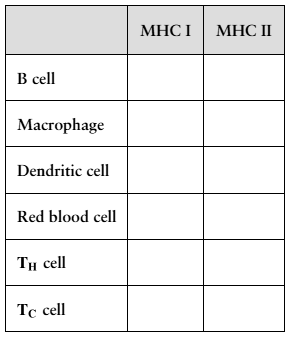
Complete the table to indicate which MHCs are present for each cell.
Problem 6
Why are packed red blood cells not tissue typed? Select all that apply.
a. Red blood cells lack MHC II
b. Red blood cells lack MHC I
c. Red blood cells can’t stimulate an immune response
d. Red blood cells aren’t transferred to others
e. Red blood cells don’t make antibodies and therefore do not need to be typed
Problem 7
Which of the following does not generate long-term immunological memory? Select all that apply.
a. Antivenom
b. Antitoxins
c. Vaccinations
d. Breast-feeding
e. Antigens
Problem 8
T helper cells activate B cells to become ________________, which make ________________.
Problem 9
Compare and contrast T-dependent and T-independent antigens.
Problem 10
Choose the false statement about T cytotoxic cells.
a. They stimulate B cells
b. They destroy virus-infected cells
c. They destroy cancer cells
d. They are activated by MHC I bound to antigens on APCs
e. They mediate the cellular branch of adaptive immunity
Problem 11
Where do T cells undergo self-tolerance selection?
Problem 12
Which of the following is not a function of antibodies?
a. Opsonization
b. Activating complement proteins
c. Activating T helper cells
d. Enhancing phagocytosis
e. Antigen neutralization
Problem 13
The distinct feature of an antigen that stimulates an adaptive immune response is called a(n) ________________.
Problem 14
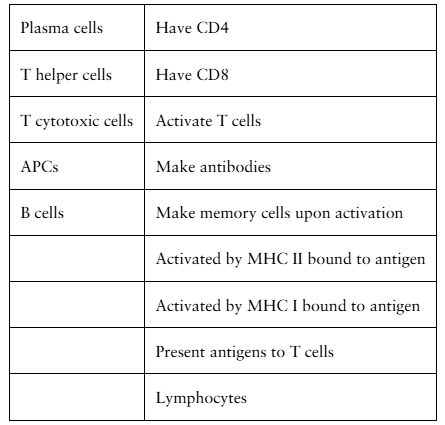
Match the cell to its stated feature. Some features will be assigned more than once.
Problem 14.9a
____________ active immunity creates ____________ lymphocytes that will remember a pathogen and quickly respond to the same pathogen later when exposed.
Problem 15
What is opsonization, and which antibodies have opsonizing activity?
Problem 16
Why is a second signal useful in T cell activation?
Problem 17
Antigen ________ is a scenario in which pathogen antigens resemble host antigens. Antigen ________ is a scenario in which the pathogen changes its antigens. These are just a couple of ways that pathogens may avoid host immune system detection.
Problem 17a
Select all the false statements about artificially acquired immunity.
a. It can be passive
b. It can be active
c. It may be generated by vaccines
d. It is a form of autoimmunity
e. It may generate memory cells
f. An example includes the transfer of antibodies across the placenta
Problem 18
List the antibody isotype(s) that exhibit the stated feature. Some features will be assigned to more than one antibody.
Feature:
Most abundant antibody in serum
Made as a dimer
Stimulates allergic responses
Does not cross the placenta
Considered a complement activator
Rare antibody that’s poorly characterized
Main antibody in breast milk and mucus
Dominates the secondary immune response
Made early in the course of infection
Made in a primary immune response
Problem 19
What is IgA protease, and what effect would it possibly have on host immune function?
Problem 19a
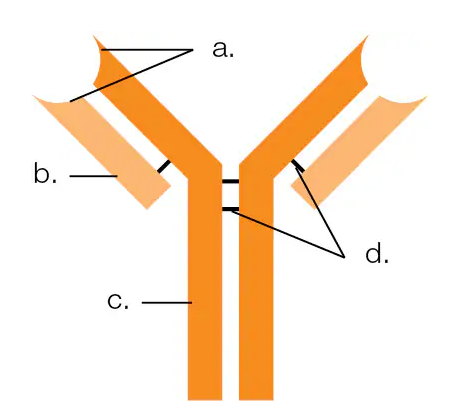
Label the indicated parts of the antibody.
Problem 20
Match the T helper cell subset to its function. Some choices may not be used, and some may be used more than once.