Antigen ________ is a scenario in which pathogen antigens resemble host antigens. Antigen ________ is a scenario in which the pathogen changes its antigens. These are just a couple of ways that pathogens may avoid host immune system detection.
Ch. 12 - Adaptive Immunity

Norman-McKay2nd EditionMicrobiology: Basic and Clinical PrinciplesISBN: 9780137661619Not the one you use?Change textbook
Chapter 12, Problem 18
List the antibody isotype(s) that exhibit the stated feature. Some features will be assigned to more than one antibody.
Feature:
Most abundant antibody in serum
Made as a dimer
Stimulates allergic responses
Does not cross the placenta
Considered a complement activator
Rare antibody that’s poorly characterized
Main antibody in breast milk and mucus
Dominates the secondary immune response
Made early in the course of infection
Made in a primary immune response
Verified step by step guidance1
Identify the antibody isotypes: IgG, IgA, IgM, IgE, and IgD are the main classes to consider.
For 'Most abundant antibody in serum', recall that IgG is the most prevalent antibody found in the bloodstream.
For 'Made as a dimer', remember that IgA is commonly secreted as a dimer, especially in mucosal areas.
For 'Stimulates allergic responses', recognize that IgE is responsible for mediating allergic reactions.
For 'Does not cross the placenta', note that IgM, IgA, IgE, and IgD generally do not cross the placenta, but IgG does.

Verified video answer for a similar problem:
This video solution was recommended by our tutors as helpful for the problem above.
Video duration:
2mWas this helpful?
Key Concepts
Here are the essential concepts you must grasp in order to answer the question correctly.
Antibody Isotypes and Their Functions
Antibody isotypes (IgG, IgA, IgM, IgE, IgD) differ in structure, location, and immune roles. Each isotype has unique features like serum abundance, ability to cross the placenta, or involvement in allergic reactions, which are critical for identifying their functions in immune responses.
Recommended video:
Guided course
Antibodies
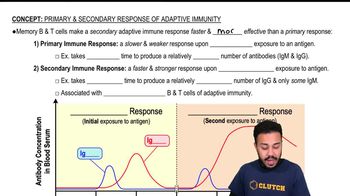
Primary vs. Secondary Immune Response
The primary immune response occurs upon first exposure to an antigen, producing mainly IgM antibodies early on. The secondary response is faster and stronger, dominated by IgG antibodies, reflecting immunological memory and improved pathogen clearance.
Recommended video:
Guided course
Primary and Secondary Response of Adaptive Immunity
Antibody Structure and Secretory Forms
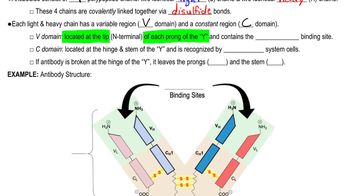
Antibodies can exist as monomers, dimers, or pentamers; for example, IgA is often secreted as a dimer in mucosal areas, while IgM is a pentamer in serum. These structural differences influence their function, such as mucosal immunity or complement activation.
Recommended video:
Guided course
Antibody Structure
Related Practice
Textbook Question
1462
views
Textbook Question
What is IgA protease, and what effect would it possibly have on host immune function?
1650
views
Textbook Question
Select all the false statements about artificially acquired immunity.
a. It can be passive
b. It can be active
c. It may be generated by vaccines
d. It is a form of autoimmunity
e. It may generate memory cells
f. An example includes the transfer of antibodies across the placenta
1495
views
Textbook Question
Match the T helper cell subset to its function. Some choices may not be used, and some may be used more than once.
1280
views
Textbook Question
Label the indicated parts of the antibody.
1515
views
Textbook Question
Why is a second signal useful in T cell activation?
1889
views
