Ch. 35 - Diffraction
Giancoli Douglas - Physics for Scientists and Engineers 5th edition
Giancoli Douglas5th editionPhysics for Scientists and EngineersISBN: 9780137488179Not the one you use?Change textbook
Chapter 34, Problem 47a

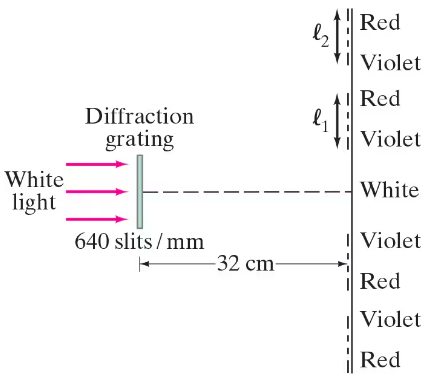
(II) White light passes through a 640-slit/ mm diffraction grating. First-order and second-order visible spectra (“rainbows”) appear on the wall 32 cm away as shown in Fig. 35–40. Determine the widths ℓ₁ and ℓ₂ of the two “rainbows” (400 nm to 700 nm). In which order is the “rainbow” dispersed over a larger distance?

Verified step by step guidance
1
Step 1: Understand the problem. A diffraction grating with 640 slits per millimeter is used to produce first-order and second-order spectra of white light. The task is to calculate the widths (ℓ₁ and ℓ₂) of the rainbows for the first and second orders, corresponding to the wavelength range of 400 nm to 700 nm. The wall is 32 cm away from the grating.
Step 2: Convert the given grating information into a usable form. The number of slits per millimeter is 640, so the slit spacing (d) can be calculated as: d = 1 / (640 × 10³) meters. This gives the distance between adjacent slits in the grating.
Step 3: Use the diffraction grating equation to find the angular positions of the wavelengths at the edges of the spectrum for each order. The equation is: mλ = d sin(θ), where m is the order of diffraction, λ is the wavelength, d is the slit spacing, and θ is the diffraction angle. Solve for θ for both 400 nm and 700 nm wavelengths in the first order (m = 1) and second order (m = 2).
Step 4: Calculate the linear positions of the wavelengths on the wall. The linear position (y) on the wall is related to the angle θ by the formula: y = L tan(θ), where L is the distance from the grating to the wall (32 cm or 0.32 m). Compute y for both 400 nm and 700 nm wavelengths in the first and second orders.
Step 5: Determine the widths of the rainbows. The width of the rainbow (ℓ) is the difference between the linear positions of the 700 nm and 400 nm wavelengths: ℓ = y(700 nm) - y(400 nm). Perform this calculation for both the first and second orders to find ℓ₁ and ℓ₂. Compare the two widths to determine which order has the larger dispersion.

Verified video answer for a similar problem:

This video solution was recommended by our tutors as helpful for the problem above.
Video duration:
11m
Was this helpful?

Key Concepts

Here are the essential concepts you must grasp in order to answer the question correctly.

Diffraction Grating

A diffraction grating is an optical component with a periodic structure that splits and diffracts light into several beams traveling in different directions. The angle at which light is diffracted depends on the wavelength and the spacing of the slits. This principle is crucial for understanding how different wavelengths of light are separated, leading to the formation of visible spectra.
Recommended video:

Order of Diffraction

The order of diffraction refers to the integer multiples of the wavelength that determine the angles at which light is constructively interfered. The first-order spectrum corresponds to the first angle where constructive interference occurs, while the second-order spectrum corresponds to the second angle. Higher orders result in wider dispersion of light, which is essential for analyzing the distances between the 'rainbows' produced.
Recommended video:

Wavelength and Color Dispersion

Wavelength is a fundamental property of light that determines its color; shorter wavelengths correspond to blue light, while longer wavelengths correspond to red light. In a diffraction grating setup, different wavelengths are dispersed at different angles, leading to a spectrum of colors. Understanding how wavelength affects the dispersion helps in calculating the widths of the 'rainbows' and determining which order disperses over a larger distance.
Recommended video:
Guided course
05:42
Unknown Wavelength of Laser through Double Slit
Related Practice
Textbook Question

A diffraction grating has 15,000 rulings in its 1.9 cm width. Determine (a) its resolving power in first and second orders, and (b) the minimum wavelength resolution (∆λ) it can yield for λ = 410 nm.

1440
views

Textbook Question

(II) X-rays of wavelength 0.138 nm fall on a crystal whose atoms, lying in planes, are spaced 0.315 nm apart. At what angle Φ (relative to the surface, Fig. 35–28) must the X-rays be directed if the first diffraction maximum is to be observed?

52
views
Textbook Question

Red laser light from a He–Ne laser (λ = 632.8 nm) creates a second-order fringe at 53.2° after passing through a grating. What is the wavelength λ of light that creates a first-order fringe at 21.2°?

1389
views
Textbook Question

Suppose the angles measured in Problem 42 were produced when the spectrometer (but not the source) was submerged in water. What then would be the wavelengths (in air)?

1417
views
Textbook Question

Show that the second- and third-order spectra of white light produced by a diffraction grating always overlap. What wavelengths overlap?

43
views
Textbook Question

(II) (a) Suppose for a conventional X-ray image that the X-ray beam consists of parallel rays. What would be the magnification of the image? (b) Suppose, instead, that the X-rays come from a point source (as in Fig. 35–31) that is 15 cm in front of a human body which is 25 cm thick, and the film is pressed against the person’s back. Determine and discuss the range of magnifications that result.


<IMAGE>

52
views