Ch. 34 - The Wave Nature of Light: Interference and Polarization
Giancoli Douglas - Physics for Scientists and Engineers 5th edition
Giancoli Douglas5th editionPhysics for Scientists and EngineersISBN: 9780137488179Not the one you use?Change textbook
Chapter 33, Problem 94

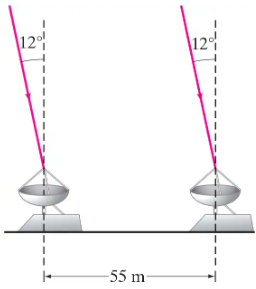
A radio telescope, whose two antennas are separated by 55 m, is designed to receive 3.0-MHz radio waves produced by astronomical objects. The received radio waves create 3.0-MHz electronic signals in the telescope’s left and right antennas. These signals then travel by equal-length cables to a centrally located amplifier, where they are added together. The telescope can be “pointed” to a certain region of the sky by adding the instantaneous signal from the right antenna to a “time-delayed” signal received by the left antenna a time ∆t ago. (This time delay of the left signal can be easily accomplished with the proper electronic circuit.) If a radio astronomer wishes to “view” radio signals arriving from an object oriented at a 12° angle to the vertical as in Fig. 34–54, what time delay ∆t is necessary?

Verified step by step guidance
1
Determine the wavelength of the radio waves using the formula: λ = c / f, where c is the speed of light (approximately 3.0 × 10^8 m/s) and f is the frequency of the radio waves (3.0 MHz).
Calculate the path difference between the signals received by the two antennas. The path difference is given by d * sin(θ), where d is the separation between the antennas (55 m) and θ is the angle of the incoming wave relative to the vertical (12°).
Relate the path difference to the time delay ∆t. The time delay is given by ∆t = path difference / c, where c is the speed of light.
Substitute the values for the path difference and the speed of light into the formula for ∆t to calculate the required time delay.
Verify the units and ensure that the time delay ∆t is expressed in seconds, as this is the standard unit for time in physics.

Verified video answer for a similar problem:

This video solution was recommended by our tutors as helpful for the problem above.
Video duration:
3m
Was this helpful?

Key Concepts

Here are the essential concepts you must grasp in order to answer the question correctly.

Wave Properties

Radio waves, like all electromagnetic waves, have properties such as frequency and wavelength. The frequency of a wave is the number of cycles that pass a point per second, measured in hertz (Hz). In this case, the radio waves have a frequency of 3.0 MHz, which influences their wavelength and how they interact with the antennas. Understanding these properties is crucial for analyzing how signals are received and processed.
Recommended video:
Guided course
06:32
Properties of Standing Waves from Wave Functions

Time Delay and Signal Processing

Time delay in signal processing refers to the intentional delay introduced to synchronize signals from different sources. In this scenario, the left antenna's signal is delayed by a time ∆t to align with the right antenna's signal. This synchronization is essential for accurately determining the direction of incoming radio waves, as it allows the telescope to effectively combine signals and enhance the detection of astronomical objects.
Recommended video:
Guided course
08:45
Traffic Signal

Angle of Arrival

The angle of arrival is the angle at which a wavefront reaches an observer or detector. In this case, the radio signals are arriving at a 12° angle to the vertical, which affects the path length of the signals received by the two antennas. This angle is critical for calculating the necessary time delay ∆t, as it determines how much longer the signal from one antenna takes to reach the amplifier compared to the other.
Recommended video:
Guided course
01:04
Critical Angle