
Textbook Question
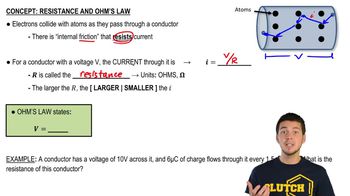
(a) What is the current in the 13-Ω heating element of a 240-V clothes dryer?
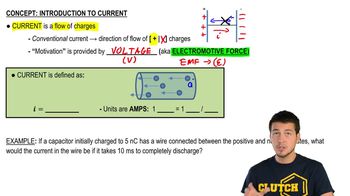
(b) How much charge passes through the element in 15 min? (Assume direct current.)
1260
views

 Verified step by step guidance
 03:07
03:07
 05:38
05:38 01:06
01:06(a) What is the current in the 13-Ω heating element of a 240-V clothes dryer?
(b) How much charge passes through the element in 15 min? (Assume direct current.)
The filament of an incandescent lightbulb has a resistance of 12 Ω at 20°C and 140 Ω when hot.
(a) Calculate the temperature of the filament when it is hot, and take into account the change in length and area of the filament due to thermal expansion (assume tungsten for which the thermal expansion coefficient is ≈ 5.5 10⁻⁶ C°⁻¹ ).
(b) In this temperature range, what is the percentage change in resistance due to thermal expansion, and what is the percentage change in resistance due solely to the change in ρ? Use Eq. 25–5.
A 12-V battery causes a current of 0.50 A through a resistor. How many joules of energy does the battery lose in a minute?
A rectangular solid made of carbon has sides of lengths 1.0 cm, 2.0 cm, and 4.0 cm, lying along the x, y, and z axes, respectively (Fig. 25–36). Determine the resistance for current that passes through the solid in the y direction, (Assume the resistivity is ρ = 3.0 x 10⁻⁵ Ω•m).
Neglect the internal resistance of a battery unless the problem refers to it. Ten 7.0-W Christmas tree lights are connected in series to each other and to a 120-V source. What is the resistance of each bulb?
Calculate the terminal voltage for a battery with an internal resistance of 0.900 Ω and an emf of 6.00 V when the battery is connected in series with a 61.0-Ω resistor.