
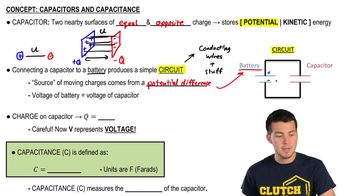
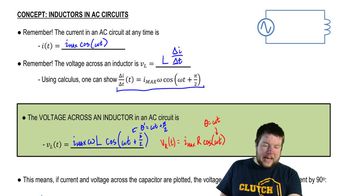
(a) Compute the reactance of a 0.450-H inductor at frequencies of 60.0 Hz and 600 Hz. (b) Compute the reactance of a 2.50-μF capacitor at the same frequencies. (c) At what frequency is the reactance of a 0.450-H inductor equal to that of a 2.50-μF capacitor?
A capacitor is connected across an ac source that has voltage amplitude 60.0 V and frequency 80.0 Hz. What is the phase angle Φ for the source voltage relative to the current? Does the source voltage lag or lead the current?
Verified step by step guidance
Verified video answer for a similar problem:
Key Concepts
Capacitive Reactance
Phase Angle in AC Circuits
Voltage and Current Relationship in Capacitors
You have a special light bulb with a very delicate wire filament. The wire will break if the current in it ever exceeds 1.50 A, even for an instant. What is the largest root-mean-square current you can run through this bulb?
A capacitor is connected across an ac source that has voltage amplitude 60.0 V and frequency 80.0 Hz. What is the capacitance C of the capacitor if the current amplitude is 5.30 A?
A capacitance C and an inductance L are operated at the same angular frequency. (a) At what angular frequency will they have the same reactance? (b) If L = 5 00 mH and C = 3.50 μF, what is the numerical value of the angular frequency in part (a), and what is the reactance of each element?
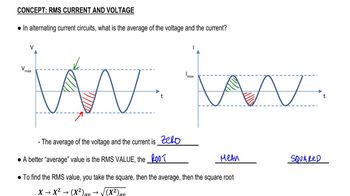
The voltage across the terminals of an ac power supply varies with time according to Eq. (31.1) v = Vcosωt. The voltage amplitude is V = 45.0 V. What are (a) the root-mean-square potential difference Vrms and (b) the average potential difference Vav between the two terminals of the power supply?
A sinusoidal current i = I cosωt has an rms value Irms = 2.10 A. What is the current amplitude?
