Ch. 30 - Inductance, Electromagnetic Oscillations, and AC Circuits
Giancoli Douglas - Physics for Scientists and Engineers 5th edition
Giancoli Douglas5th editionPhysics for Scientists and EngineersISBN: 9780137488179Not the one you use?Change textbook
Chapter 29, Problem 22

(III) Determine the emf induced in the square loop in Fig. 29–52 if the loop stays at rest and the current in the straight wire is given by I(t) = (15.0 A) sin (2200 t) where t is in seconds. The distance a is 12.0 cm, and b is 15.0 cm.

Verified step by step guidance
1
Understand the problem: The goal is to calculate the electromotive force (emf) induced in the square loop due to the changing magnetic field created by the current in the nearby straight wire. The current in the wire is time-dependent, given by I(t) = (15.0 A) sin(2200 t). The distances a and b represent the positions of the loop relative to the wire.
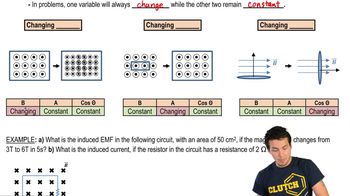
Step 1: Recall Faraday's Law of Induction, which states that the induced emf (ε) in a loop is given by the negative rate of change of magnetic flux through the loop: ε = -dΦ/dt. Here, Φ is the magnetic flux, which is the product of the magnetic field (B) and the area (A) of the loop, integrated over the loop's surface.
Step 2: Determine the magnetic field (B) due to the straight wire at a distance r. Using Ampere's Law, the magnetic field at a distance r from a long straight wire carrying current I is given by B = (μ₀ I) / (2π r), where μ₀ is the permeability of free space (μ₀ = 4π × 10⁻⁷ T·m/A).
Step 3: Calculate the magnetic flux (Φ) through the square loop. The magnetic field varies with distance r, so you need to integrate B over the area of the loop. The flux is given by Φ = ∫(B dA), where dA is the differential area element. Since the loop is rectangular, the integration limits for r will be from a to b, and the width of the loop (w) is constant.
Step 4: Differentiate the magnetic flux (Φ) with respect to time (t) to find the induced emf (ε). Since the current I(t) is time-dependent, substitute I(t) = (15.0 A) sin(2200 t) into the expression for B, and then calculate dΦ/dt. Finally, apply the negative sign from Faraday's Law to determine the emf.

Verified video answer for a similar problem:

This video solution was recommended by our tutors as helpful for the problem above.
Video duration:
12m
Was this helpful?

Key Concepts

Here are the essential concepts you must grasp in order to answer the question correctly.

Electromagnetic Induction

Electromagnetic induction is the process by which a changing magnetic field within a closed loop induces an electromotive force (emf) in the loop. This phenomenon is described by Faraday's Law, which states that the induced emf is proportional to the rate of change of magnetic flux through the loop. In this scenario, the changing current in the straight wire generates a varying magnetic field, which affects the square loop.
Recommended video:
Guided course
05:42
Introduction to Induction

Faraday's Law of Induction

Faraday's Law of Induction quantifies the induced emf in a circuit due to a changing magnetic field. It can be mathematically expressed as ε = -dΦ/dt, where ε is the induced emf and Φ is the magnetic flux. The negative sign indicates the direction of the induced emf opposes the change in magnetic flux, a principle known as Lenz's Law. This law is crucial for calculating the emf in the given problem.
Recommended video:
Guided course
09:26
Faraday's Law

Magnetic Flux

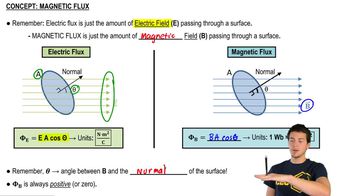
Magnetic flux is a measure of the quantity of magnetism, taking into account the strength and the extent of a magnetic field over a given area. It is defined as the product of the magnetic field strength and the area through which the field lines pass, adjusted for the angle between the field lines and the normal to the surface. In this problem, the magnetic flux through the square loop changes as the current in the wire varies, leading to the induced emf.
Recommended video:
Guided course
04:52
Magnetic Flux
Related Practice
Textbook Question

(II) For the toroid of Fig. 30–26, determine the energy density in the magnetic field as a function of r(r₁ < r < r₂) and integrate this over the volume to obtain the total energy stored in the toroid, which carries a current I in each of its N loops.


<IMAGE>

124
views
Textbook Question

Two tightly wound solenoids have the same length and circular cross-sectional area. But solenoid 1 uses wire that is 1.5 times as thick as solenoid 2.

(a) What is the ratio of their inductances?

(b) What is the ratio of their inductive time constants? (Assume the only resistance in the circuits is that of the wire itself.)

1362
views
Textbook Question

What is the energy density at the center of a circular loop of wire carrying a 19.0-A current if the radius of the loop is 28.0 cm?

155
views
Textbook Question

(II) (a) Determine the energy stored in the inductor L as a function of time for the LR circuit of Fig. 30–6a. (b) After how many time constants does the stored energy reach 99.9% of its maximum value?

1542
views
Textbook Question

(II) (a) In Fig. 30–28, assume that the switch has been in position A for sufficient time so that a steady current I₀ = V₀/R flows through the resistor R. At time t = 0, the switch is quickly switched to position B and the current decays through resistor R' (which is much greater than R) according to I=I0et/τI = I_0 e^{-t/\(\tau\)'}I=I0et/τI = I_0 e^{-t/\(\tau\)'}. Show that the maximum emf εmax induced in the inductor during this time period is (R'/R)Vo. (b) If R' = 45R and Vo = 145 V, determine εmax. [When a mechanical switch is opened, a high-resistance air gap is created, which is modeled as R' here. This Problem illustrates why high-voltage sparking can occur if a current-carrying inductor is suddenly cut off from its power source. The very high voltage can produce an electric field great enough to ionize atoms of air, which emit light when electrons recombine with the ions.]

1378
views
Textbook Question

The magnetic field inside an air-filled solenoid 38.0 cm long and 2.10 cm in diameter is 0.720 T. Approximately how much energy is stored in this field?

123
views