
Ch. 08 - Conservation of Energy
Giancoli Douglas - Physics for Scientists and Engineers 5th edition
Giancoli Douglas5th editionPhysics for Scientists and EngineersISBN: 9780137488179Not the one you use?Change textbook
Chapter 8, Problem 97

How much work can a 3.0-hp motor do in 1.0h?

Verified step by step guidance
1
Step 1: Understand the relationship between power, work, and time. The formula to calculate work is: W = P × t, where W is work, P is power, and t is time.
Step 2: Convert the power from horsepower (hp) to watts (W). Use the conversion factor: 1 \, hp = 746 \, W. Multiply the given power (3.0 hp) by 746 W/hp to express it in watts.
Step 3: Convert the time from hours to seconds, as the SI unit of power (watts) is based on seconds. Use the conversion factor: 1 \, h = 3600 \, s. Multiply the given time (1.0 h) by 3600 s/h to express it in seconds.
Step 4: Substitute the converted values of power (in watts) and time (in seconds) into the formula W = P × t to calculate the work done.
Step 5: Simplify the expression to find the total work done by the motor in joules (J), as work is measured in joules in the SI system.

Verified video answer for a similar problem:

This video solution was recommended by our tutors as helpful for the problem above.
Video duration:
3m
Was this helpful?

Key Concepts

Here are the essential concepts you must grasp in order to answer the question correctly.

Work

In physics, work is defined as the product of force and displacement in the direction of the force. It is calculated using the formula W = F × d, where W is work, F is the force applied, and d is the distance moved. Work is measured in joules (J) in the SI system, and it quantifies the energy transferred when an object is moved by an external force.
Recommended video:
Guided course
06:58
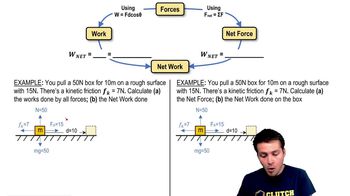
Calculating Net Work

Horsepower

Horsepower (hp) is a unit of power that measures the rate at which work is done. One horsepower is equivalent to approximately 746 watts. In the context of motors, horsepower indicates how much work the motor can perform over time, allowing for the comparison of different motors' capabilities in terms of energy output.
Recommended video:
Guided course
06:58
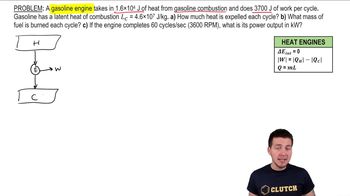
Power Output of a Gasoline Engine

Power and Time Relationship

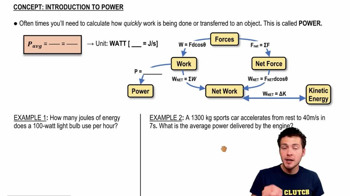
Power is defined as the rate at which work is done or energy is transferred over time. The relationship can be expressed as P = W/t, where P is power, W is work, and t is time. This means that to find the total work done by a motor over a specific time period, one can rearrange the formula to W = P × t, allowing for the calculation of work based on the motor's power rating and the duration of operation.
Recommended video:
Related Practice
Textbook Question

Suppose we have three masses, m₁ , m₂ and m₃, that initially are extremely (≈ infinitely) far apart from each other. The work needed to bring them to the positions shown in Fig. 8–50 is W = - G ((m₁m₂/ r₁₂) + (m₁m₃/r₁₃) + (m₂m₃/r₂₃)). Is W equal to the binding energy of the system—that is, is W equal to the energy required to separate the components by an infinite distance? Explain.

1491
views
Textbook Question

Proper design of automobile braking systems must account for heat buildup under heavy braking. Calculate the thermal energy dissipated from brakes in a 1500-kg car that descends a 17° hill. The car begins braking when its speed is 95 km/h and slows to a speed of 35 km/h in a distance of 0.30 km measured along the road.

1617
views
Textbook Question

The two atoms in a diatomic molecule exert an attractive force on each other at large distances and a repulsive force at short distances. The magnitude of the force between two atoms in a diatomic molecule can be approximated by the Lennard-Jones force, or F(r) = F₀ [2(σ/r)¹³ - (σ/r)⁷], where r is the separation between the two atoms, and σ and F₀ are constants. For an oxygen molecule (which is diatomic) F₀ = 9.60 x 10⁻¹¹ N and σ = 3.50 x 100⁻¹¹ m. Integrate the equation for F(r) to determine the potential energy U(r) of the oxygen molecule.

1588
views
Textbook Question

If you stand on a bathroom scale, the spring inside the scale compresses 0.60 mm, and it tells you your weight is 760 N. Now if you jump on the scale from a height of 1.0 m, what does the scale read at its peak? Assume Hooke’s law holds.

1306
views