
Ch. 25 - Electric Current and Resistance
Giancoli Douglas - Physics for Scientists and Engineers 5th edition
Giancoli Douglas5th editionPhysics for Scientists and EngineersISBN: 9780137488179Not the one you use?Change textbook
Chapter 24, Problem 95b

Household wiring has sometimes used aluminium instead of copper.Typical copper wire used for home wiring in the U.S. has a diameter of 1.63 mm. What is the resistance of 125 m of this wire?

Verified step by step guidance
1
Determine the formula for resistance using the resistivity equation: \( R = \frac{\rho L}{A} \), where \( R \) is resistance, \( \rho \) is the resistivity of the material, \( L \) is the length of the wire, and \( A \) is the cross-sectional area of the wire.
Look up the resistivity \( \rho \) of copper. For copper, \( \rho \approx 1.68 \times 10^{-8} \; \Omega \cdot \text{m} \).
Calculate the cross-sectional area \( A \) of the wire using the formula for the area of a circle: \( A = \pi r^2 \), where \( r \) is the radius of the wire. The diameter is given as 1.63 mm, so \( r = \frac{1.63}{2} \; \text{mm} = 0.815 \; \text{mm} = 0.815 \times 10^{-3} \; \text{m} \).
Substitute the values for \( \rho \), \( L \), and \( A \) into the resistance formula. The length \( L \) is given as 125 m, and \( A \) was calculated in the previous step.
Simplify the expression to find the resistance \( R \). Ensure that all units are consistent (e.g., meters for length and square meters for area) before performing the calculation.

Verified video answer for a similar problem:

This video solution was recommended by our tutors as helpful for the problem above.
Video duration:
2m
Was this helpful?

Key Concepts

Here are the essential concepts you must grasp in order to answer the question correctly.

Resistance

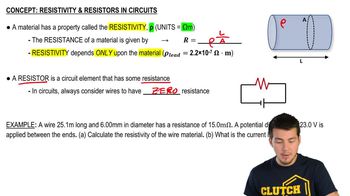
Resistance is a measure of the opposition to the flow of electric current in a conductor. It is determined by the material's properties, length, and cross-sectional area. The formula for resistance (R) is given by R = ρ(L/A), where ρ is the resistivity of the material, L is the length of the wire, and A is the cross-sectional area. Understanding resistance is crucial for calculating how much current will flow through a wire for a given voltage.
Recommended video:
Guided course
05:25
Resistivity & Resistors in Circuits

Resistivity

Resistivity is a fundamental property of materials that quantifies how strongly they resist electric current. It is denoted by the symbol ρ and is measured in ohm-meters (Ω·m). Different materials have different resistivities; for example, copper has a low resistivity, making it an excellent conductor, while aluminum has a higher resistivity. This property is essential for determining the resistance of a wire based on its material and dimensions.
Recommended video:
Guided course
05:25
Resistivity & Resistors in Circuits

Cross-sectional Area

The cross-sectional area of a wire is the area of its circular end face, which affects its resistance. It is calculated using the formula A = π(d/2)², where d is the diameter of the wire. A larger cross-sectional area results in lower resistance, allowing more current to flow through the wire. This concept is vital when comparing different wire materials and sizes in electrical applications.
Recommended video:
Guided course
08:10
Calculating the Vector (Cross) Product Using Components
Related Practice
Textbook Question

Small changes in the length of an object can be measured using a strain gauge sensor, which is a wire that when undeformed has length ℓ₀, cross-sectional area A₀, and resistance R₀. This sensor is rigidly affixed to the object’s surface, aligning its length in the direction in which length changes are to be measured. As the object deforms, the length of the wire sensor changes by Δℓ, and the resulting change ΔR in the sensor’s resistance is measured. Assuming that as the solid wire is deformed to a length ℓ, its density and volume remain constant (only approximately valid), show that the strain ( = Δℓ / ℓ₀ ) of the wire sensor, and thus of the object to which it is attached, is approximately ΔR / 2R₀.

713
views
Textbook Question

The level of liquid helium (temperature ≈ 4K) in its storage tank can be monitored using a vertically aligned niobium–titanium (NbTi) wire, whose length ℓ spans the height of the tank. In this level-sensing setup, an electronic circuit maintains a constant electrical current I at all times in the NbTi wire and a voltmeter monitors the voltage V across this wire. The NbTi wire is superconducting ( R = 0) if below its transition temperature of 10 K, so the portion of the wire immersed in the liquid helium is in the superconducting state, while the portion above the liquid (in helium vapor with temperature above 10 K) is in the normal state. Define ƒ = x/ℓ to be the fraction of the tank filled with liquid helium (Fig. 25–40) and V₀ to be the value of the voltage V when the tank is empty (ƒ = 0) . Determine the relation between f and V (in terms of V₀).

763
views
Textbook Question

Lightbulb A is rated at 120 V and 40 W for household applications. Lightbulb B is rated at 12 V and 40 W for automotive applications. What is the resistance of each bulb?

1016
views
Textbook Question

Estimate how far can an average electron move along one of the connecting wires of a 750-W toaster during an alternating current cycle? The power cord has copper wires of diameter 1.7 mm and is plugged into a 60-Hz 120-V ac outlet. [Hint: For sinusoidal motion, Chapter 14, we saw that the maximum distance traveled from equilibrium (amplitude A) is proportional to the maximum (drift) speed (Eq. 14–9a). This maximum drift speed is related to the maximum current (Section 25–8), which is calculated as the first step here; see Chapter 14.]

1187
views
Textbook Question

Household wiring has sometimes used aluminium instead of copper. What would be the resistance of the same wire if it were made of aluminum?

1130
views
Textbook Question

Copper wire of diameter 0.259 cm is used to connect a set of appliances at 120 V, which draw 1250 W of power total. What power is wasted in 25.0 m of this wire?

1103
views