
A 2.20-kg hoop 1.20 m in diameter is rolling to the right without slipping on a horizontal floor at a steady 2.60 rad/s. Find the velocity vector of each of the following points, as viewed by a person at rest on the ground: (i) the highest point on the hoop; (ii) the lowest point on the hoop; (iii) a point on the right side of the hoop, midway between the top and the bottom.
A solid ball is released from rest and slides down a hillside that slopes downward at 65.0° from the horizontal. In part (a), why did we use the coefficient of static friction and not the coefficient of kinetic friction?
Verified step by step guidance
Verified video answer for a similar problem:
Key Concepts
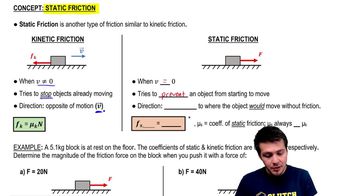
Static Friction
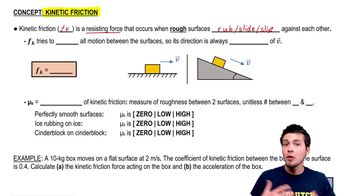
Kinetic Friction
Transition from Rest to Motion
A bicycle racer is going downhill at 11.0 m/s when, to his horror, one of his 2.25-kg wheels comes off as he is 75.0 m above the foot of the hill. We can model the wheel as a thin-walled cylinder 85.0 cm in diameter and ignore the small mass of the spokes. How much total kinetic energy does the wheel have when it reaches the bottom of the hill?
A playground merry-go-round has radius and moment of inertia about a vertical axle through its center, and it turns with negligible friction. A child applies an force tangentially to the edge of the merry-go-round for . If the merry-go-round is initially at rest, how much work did the child do on the merry-go-round?
A 2.20-kg hoop 1.20 m in diameter is rolling to the right without slipping on a horizontal floor at a steady 2.60 rad/s. Find the velocity vector for each of the points in part (c), but this time as viewed by someone moving along with the same velocity as the hoop.
A 12.0-kg box resting on a horizontal, frictionless surface is attached to a 5.00-kg weight by a thin, light wire that passes over a frictionless pulley (Fig. E10.16). The pulley has the shape of a uniform solid disk of mass 2.00 kg and diameter 0.500 m. After the system is released, find the acceleration of the box.
A playground merry-go-round has radius and moment of inertia about a vertical axle through its center, and it turns with negligible friction. A child applies an force tangentially to the edge of the merry-go-round for . If the merry-go-round is initially at rest, what is its angular speed after this interval?
