Ch. 25 - Electric Current and Resistance
Giancoli Douglas - Physics for Scientists and Engineers 5th edition
Giancoli Douglas5th editionPhysics for Scientists and EngineersISBN: 9780137488179Not the one you use?Change textbook
Chapter 24, Problem 78b

A 2800-W oven is connected to a 240-V source. How long will it take to bring 150 mL of 15°C water to 100°C assuming 65% efficiency?

Verified step by step guidance
1
Determine the energy required to heat the water using the formula: Q = mcΔT, where m is the mass of the water, c is the specific heat capacity of water (approximately 4.186 J/g°C), and ΔT is the temperature change. Convert the volume of water (150 mL) to mass (in grams) assuming the density of water is 1 g/mL.
Calculate the total energy required to heat the water from 15°C to 100°C by substituting the values into the formula. Use ΔT = 100 - 15.
Account for the efficiency of the oven. Since the oven is 65% efficient, the actual energy supplied by the oven is given by Q' = Q / 0.65, where Q is the energy calculated in the previous step.
Determine the power output of the oven using the formula: P = 2800 W. Use this power to calculate the time required to supply the energy Q' using the formula: t = Q' / P.
Substitute the values into the formula for time and solve for t. Ensure the units are consistent (e.g., energy in joules, power in watts, and time in seconds).

Verified video answer for a similar problem:

This video solution was recommended by our tutors as helpful for the problem above.
Video duration:
7m
Was this helpful?

Key Concepts

Here are the essential concepts you must grasp in order to answer the question correctly.

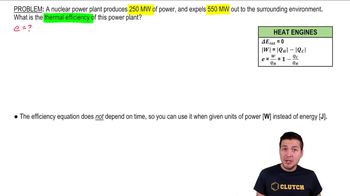
Power and Efficiency

Power is the rate at which energy is transferred or converted, measured in watts (W). In this context, the oven has a power rating of 2800 W, but its efficiency is only 65%, meaning only 65% of the power is effectively used for heating. This efficiency must be considered when calculating the actual power available for heating the water.
Recommended video:
Guided course
03:55
Efficiency of a Nuclear Power Plant

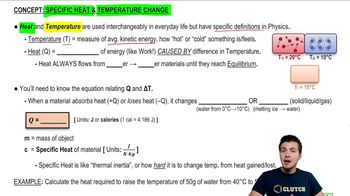
Specific Heat Capacity

Specific heat capacity is the amount of heat required to raise the temperature of a unit mass of a substance by one degree Celsius. For water, this value is approximately 4.18 J/g°C. To determine how much energy is needed to heat the water from 15°C to 100°C, we use the formula: Q = mcΔT, where Q is the heat energy, m is the mass of the water, c is the specific heat capacity, and ΔT is the change in temperature.
Recommended video:
Guided course
06:50
Specific Heat & Temperature Changes

Energy and Time Relationship

The relationship between energy, power, and time is described by the equation: Energy (E) = Power (P) × Time (t). In this scenario, once we calculate the total energy required to heat the water, we can rearrange the equation to find the time it takes for the oven to provide that energy, taking into account the effective power output based on the oven's efficiency.
Recommended video:
Guided course
03:43
Relationships Between Force, Field, Energy, Potential