
Ch. 25 - Electric Current and Resistance
Giancoli Douglas - Physics for Scientists and Engineers 5th edition
Giancoli Douglas5th editionPhysics for Scientists and EngineersISBN: 9780137488179Not the one you use?Change textbook
Chapter 24, Problem 46

Calculate the peak current in a 2.5-k Ω resistor connected to a 220-V rms ac source.

Verified step by step guidance
1
Step 1: Understand the given values and the formula to use. The problem provides the resistance \( R = 2.5 \; \text{k}\Omega = 2500 \; \Omega \) and the root mean square (rms) voltage \( V_{\text{rms}} = 220 \; \text{V} \). The goal is to calculate the peak current \( I_{\text{peak}} \).
Step 2: Recall the relationship between rms voltage and peak voltage. The peak voltage \( V_{\text{peak}} \) is related to the rms voltage by the equation: \( V_{\text{peak}} = \sqrt{2} \cdot V_{\text{rms}} \).
Step 3: Use Ohm's Law to relate the peak current to the peak voltage and resistance. Ohm's Law states \( I = \frac{V}{R} \). For peak current, this becomes \( I_{\text{peak}} = \frac{V_{\text{peak}}}{R} \).
Step 4: Substitute \( V_{\text{peak}} = \sqrt{2} \cdot V_{\text{rms}} \) into the equation for \( I_{\text{peak}} \). This gives \( I_{\text{peak}} = \frac{\sqrt{2} \cdot V_{\text{rms}}}{R} \).
Step 5: Plug in the given values \( V_{\text{rms}} = 220 \; \text{V} \) and \( R = 2500 \; \Omega \) into the equation \( I_{\text{peak}} = \frac{\sqrt{2} \cdot 220}{2500} \). Simplify the expression to find the peak current.

Verified video answer for a similar problem:

This video solution was recommended by our tutors as helpful for the problem above.
Video duration:
2m

Key Concepts

Here are the essential concepts you must grasp in order to answer the question correctly.

Ohm's Law

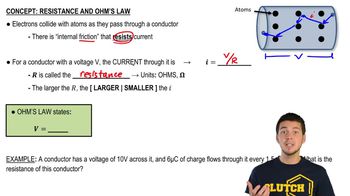
Ohm's Law states that the current (I) flowing through a conductor between two points is directly proportional to the voltage (V) across the two points and inversely proportional to the resistance (R) of the conductor. It is mathematically expressed as I = V/R. This fundamental principle is essential for calculating current in electrical circuits.
Recommended video:
Guided course
03:07
Resistance and Ohm's Law

RMS Voltage

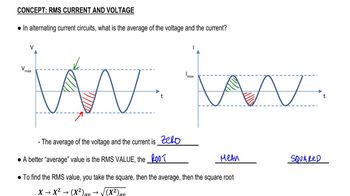
RMS (Root Mean Square) voltage is a way of expressing the effective value of an alternating current (AC) voltage. It represents the equivalent direct current (DC) voltage that would deliver the same power to a resistor. For a sinusoidal AC source, the RMS voltage is approximately 0.707 times the peak voltage, making it crucial for calculations involving AC circuits.
Recommended video:
Guided course
07:14
RMS Current and Voltage

Peak Current

Peak current refers to the maximum instantaneous current that flows through a circuit during one cycle of an AC waveform. It can be calculated from the RMS current using the relationship I_peak = I_rms × √2. Understanding peak current is important for analyzing the performance and safety of electrical components in AC circuits.
Recommended video:
Guided course
07:14
RMS Current and Voltage