
Consider two antennas radiating 6.8-MHz radio waves in phase with each other. They are located at points S₁ and S₂, separated by a distance d = 175 m, Fig. 34–50. Determine the points on the positive y-axis where the signals from the two sources will be out of phase (crests of one meet troughs of the other).
Giancoli Douglas 5th edition
Ch. 34 - The Wave Nature of Light: Interference and Polarization
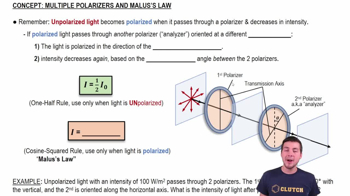
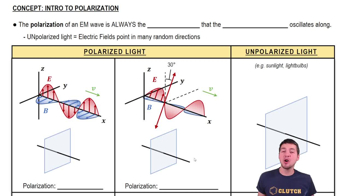
Problem 88Two polarizers are oriented at 55° to each other and plane-polarized light is incident on them. If only 25% of the light gets through both of them, what was the initial polarization direction of the incident light?
Verified step by step guidance
Verified video answer for a similar problem:
Key Concepts
Malus's Law
Polarization of Light
Intensity Ratio in Polarizers
At what angle should the axes of two Polaroids be placed so as to reduce the intensity of the incident unpolarized light by an additional factor (after the first Polaroid cuts it in half) of (a) 4, (b) 10, (c) 100?
Two narrow slits 0.070 mm apart are illuminated by a very bright 488-nm light source forming an interference pattern on a screen 4.0 m away. Calculate (a) the distance between the m = 0 and m = 1 lines in the pattern and (b) the distance between the m = 100 and m = 101 lines.
Describe how to rotate the plane of polarization of a plane-polarized beam of light by 90° and produce only a 10% loss in intensity, using polarizers. Let N be the number of polarizers and θ be the (same) angle between successive polarizers.
Unpolarized light falls on two polarizer sheets whose axes are at right angles. (a) What fraction of the incident light intensity is transmitted? (b) What fraction is transmitted if a third polarizer is placed between the first two so that its axis makes a 58° angle with the axis of the first polarizer? (c) What if the third polarizer is in front of the other two?
"Two identical sources S₁ and S₂, separated by distance d, coherently emit light of wavelength λ uniformly in all directions. Defining the x axis with its origin at S₁ as shown in Fig. 34–52, find the locations (expressed as multiples of λ ) where the signals from the two sources are out of phase along this axis for x > 0 , if d = 3λ.