Ch. 36 - The Special Theory of Relativity
Giancoli Douglas - Physics for Scientists and Engineers 5th edition
Giancoli Douglas5th editionPhysics for Scientists and EngineersISBN: 9780137488179Not the one you use?Change textbook
Chapter 35, Problem 10b

A star is 23.5 light-years from Earth. How long would it take a spacecraft traveling 0.950c to reach that star as measured by observers on the spacecraft?

Verified step by step guidance
1
Determine the distance to the star in the Earth's frame of reference, which is given as 23.5 light-years. This is the proper distance since it is measured in the rest frame of the Earth.
Identify the speed of the spacecraft as 0.950c, where c is the speed of light. This is the velocity relative to the Earth.
To calculate the time as measured by observers on the spacecraft, use the concept of time dilation from special relativity. The time dilation formula is: t=te0/1-v2/c2, where t is the time in the spacecraft's frame, te is the time in the Earth's frame, and v is the velocity of the spacecraft.
First, calculate the time in the Earth's frame of reference using the formula: te=d/v, where d is the distance (23.5 light-years) and v is the velocity (0.950c).
Substitute the value of te into the time dilation formula to find the time as measured by observers on the spacecraft. Simplify the expression to complete the calculation.

Verified video answer for a similar problem:

This video solution was recommended by our tutors as helpful for the problem above.
Video duration:
4m
Was this helpful?

Key Concepts

Here are the essential concepts you must grasp in order to answer the question correctly.

Relativity of Time

According to Einstein's theory of relativity, time is not absolute and can vary for observers in different frames of reference. For a spacecraft traveling at a significant fraction of the speed of light, time experienced by those on board (proper time) will be less than that measured by stationary observers on Earth due to time dilation.
Recommended video:
Guided course
04:27
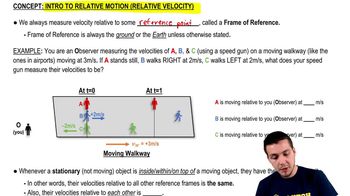
Intro to Relative Motion (Relative Velocity)

Speed of Light and 'c'

The speed of light in a vacuum, denoted as 'c', is approximately 299,792 kilometers per second. In the context of relativity, as an object approaches the speed of light, its relativistic effects become significant, affecting time, length, and mass. The spacecraft in the question travels at 0.950c, which is 95% of the speed of light.
Recommended video:
Guided course
06:03
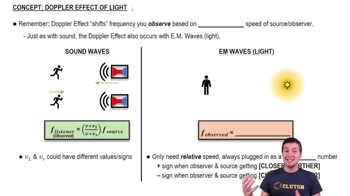
The Doppler Effect (Light)

Distance and Travel Time Calculation

To calculate the time it takes to travel a certain distance at a given speed, the formula time = distance/speed is used. However, when dealing with relativistic speeds, one must also account for time dilation, which alters the perceived travel time for observers on the spacecraft compared to those on Earth.
Recommended video:
Guided course
04:43
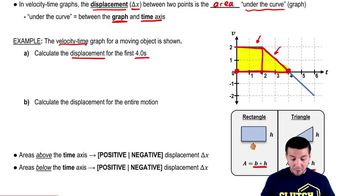
Calculating Displacement from Velocity-Time Graphs