
Pure silicon at room temperature contains approximately 1.0 × 10¹⁶ free electrons per cubic meter. (a) Referring to Table 25.1, calculate the mean free time t for silicon at room temperature. (b) Your answer in part (a) is much greater than the mean free time for copper given in Example 25.11. Why, then, does pure silicon have such a high resistivity compared to copper?
A typical small flashlight contains two batteries, each having an emf of 1.5 V, connected in series with a bulb having resistance 17 Ω. If the internal resistance of the batteries is negligible, what power is delivered to the bulb?
Verified step by step guidance
Verified video answer for a similar problem:
Key Concepts
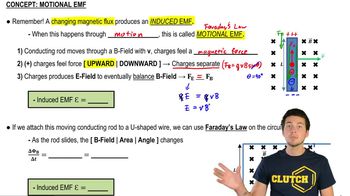
Electromotive Force (EMF)
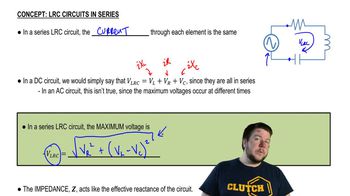
Series Circuit
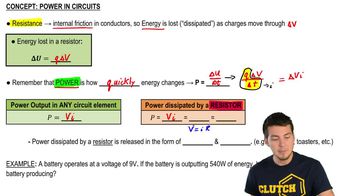
Power in Electrical Circuits
A heart defibrillator is used to enable the heart to start beating if it has stopped. This is done by passing a large current of 12 A through the body at 25 V for a very short time, usually about 3.0 ms. How much energy is transferred?
A typical small flashlight contains two batteries, each having an emf of 1.5 V, connected in series with a bulb having resistance 17 Ω. If the batteries last for 5.0 h, what is the total energy delivered to the bulb?
A typical small flashlight contains two batteries, each having an emf of 1.5 V, connected in series with a bulb having resistance 17 Ω. The resistance of real batteries increases as they run down. If the initial internal resistance is negligible, what is the combined internal resistance of both batteries when the power to the bulb has decreased to half its initial value?
The battery for a certain cell phone is rated at 3.70 V. According to the manufacturer, it can produce 3.15 × 10⁴ J of electrical energy, enough for 5.25 h of operation, before needing to be recharged. Find the average current that this cell phone draws when turned on.
Electric eels generate electric pulses along their skin that can be used to stun an enemy when they come into contact with it. Tests have shown that these pulses can be up to 500 V and produce currents of 80 mA (or even larger). A typical pulse lasts for 10 ms. What power and how much energy are delivered to the unfortunate enemy with a single pulse, assuming a steady current?
