
Ch 30: Electromagnetic Induction
Knight Calc - Physics for Scientists and Engineers 5th Edition
Knight Calc5th EditionPhysics for Scientists and EngineersISBN: 9780137344796Not the one you use?Change textbook
Chapter 30, Problem 55a

INT A 20-cm-long, zero-resistance slide wire moves outward, on zero-resistance rails, at a steady speed of 10 m/s in a 0.10 T magnetic field. (See Figure 30.26.) On the opposite side, a 1.0 Ω carbon resistor completes the circuit by connecting the two rails. The mass of the resistor is 50 mg. What is the induced current in the circuit?

Verified step by step guidance
1
Step 1: Understand the concept of electromagnetic induction. When a conductor moves through a magnetic field, an electromotive force (EMF) is induced in the conductor due to Faraday's law of induction. The EMF can be calculated using the formula: ε = Blv, where B is the magnetic field strength, l is the length of the wire, and v is the velocity of the wire.
Step 2: Substitute the given values into the formula for EMF. The magnetic field strength B is 0.10 T, the length of the wire l is 20 cm (convert to meters: 0.20 m), and the velocity v is 10 m/s. Calculate the EMF using ε = Blv.
Step 3: Use Ohm's law to find the induced current in the circuit. Ohm's law states that I = ε/R, where I is the current, ε is the EMF, and R is the resistance. The resistance of the carbon resistor is given as 1.0 Ω. Substitute the calculated EMF and the resistance into the formula to find the current.
Step 4: Verify the direction of the induced current using Lenz's law. Lenz's law states that the induced current will flow in a direction that opposes the change in magnetic flux. Analyze the setup of the circuit and the motion of the wire to determine the direction of the current.
Step 5: Consider the physical implications of the induced current. The resistor will dissipate energy as heat due to the current flowing through it. This energy dissipation can be calculated using the formula for power: P = IR2, where P is the power, I is the current, and R is the resistance.

Verified video answer for a similar problem:

This video solution was recommended by our tutors as helpful for the problem above.
Was this helpful?

Key Concepts

Here are the essential concepts you must grasp in order to answer the question correctly.

Faraday's Law of Electromagnetic Induction

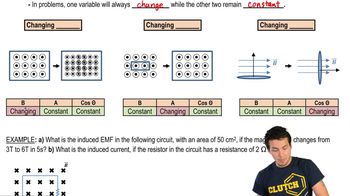
Faraday's Law states that a change in magnetic flux through a circuit induces an electromotive force (EMF) in that circuit. The induced EMF is proportional to the rate of change of the magnetic flux. In this scenario, the movement of the slide wire through the magnetic field creates a change in flux, leading to the generation of EMF and subsequently inducing current in the circuit.
Recommended video:
Guided course
09:26
Faraday's Law

Ohm's Law

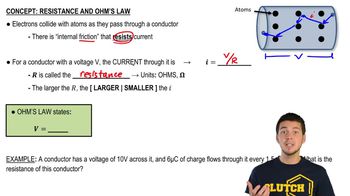
Ohm's Law relates the voltage (V), current (I), and resistance (R) in an electrical circuit, expressed as V = IR. This fundamental principle allows us to calculate the current flowing through a circuit when the voltage and resistance are known. In this problem, once the induced EMF is determined, Ohm's Law can be applied to find the induced current through the 1.0 Ω resistor.
Recommended video:
Guided course
03:07
Resistance and Ohm's Law

Magnetic Force on a Current-Carrying Conductor

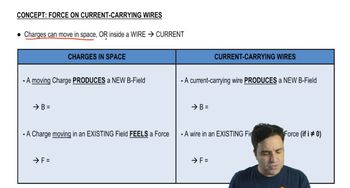
When a conductor moves through a magnetic field, it experiences a magnetic force that can affect the current flowing through it. The direction of this force is given by the right-hand rule, which helps determine the orientation of the induced current. Understanding this concept is crucial for analyzing how the motion of the slide wire in the magnetic field influences the overall circuit behavior.
Recommended video:
Guided course
09:57
Magnetic Force on Current-Carrying Wire
Related Practice
Textbook Question

INT A 20-cm-long, zero-resistance slide wire moves outward, on zero-resistance rails, at a steady speed of 10 m/s in a 0.10 T magnetic field. (See Figure 30.26.) On the opposite side, a 1.0 Ω carbon resistor completes the circuit by connecting the two rails. The mass of the resistor is 50 mg. If the wire is pulled for 10 s, what is the temperature increase of the carbon? The specific heat of carbon is 710 J/kg K.

132
views
Textbook Question

A small, 2.0-mm-diameter circular loop with R = 0.020 Ω is at the center of a large 100-mm-diameter circular loop. Both loops lie in the same plane. The current in the outer loop changes from +1.0 A to −1.0 A in 0.10 s. What is the induced current in the inner loop?

69
views
Textbook Question

CALC Your camping buddy has an idea for a light to go inside your tent. He happens to have a powerful (and heavy!) horseshoe magnet that he bought at a surplus store. This magnet creates a 0.20 T field between two pole tips 10 cm apart. His idea is to build the hand-cranked generator shown in FIGURE P30.57. He thinks you can make enough current to fully light a 1.0 Ω lightbulb rated at 4.0 W. That's not super bright, but it should be plenty of light for routine activities in the tent. Find an expression for the induced current as a function of time if you turn the crank at frequency f. Assume that the semicircle is at its highest point at t = 0 s.

70
views
Textbook Question

INT A 20-cm-long, zero-resistance slide wire moves outward, on zero-resistance rails, at a steady speed of 10 m/s in a 0.10 T magnetic field. (See Figure 30.26.) On the opposite side, a 1.0 Ω carbon resistor completes the circuit by connecting the two rails. The mass of the resistor is 50 mg. How much force is needed to pull the wire at this speed?

236
views
Textbook Question

CALC The L-shaped conductor in FIGURE P30.54 moves at 10 m/s across and touches a stationary L-shaped conductor in a 0.10 T magnetic field. The two vertices overlap, so that the enclosed area is zero, at t = 0 s. The conductor has a resistance of 0.010 ohms per meter. a. What is the direction of the induced current?

1402
views
Textbook Question

A rectangular metal loop with 0.050 Ω resistance is placed next to one wire of the RC circuit shown in FIGURE P30.53. The capacitor is charged to 20 V with the polarity shown, then the switch is closed at t = 0 s. What is the current in the loop at t = 5.0 μs? Assume that only the circuit wire next to the loop is close enough to produce a significant magnetic field.

124
views