
The liquid-drop model of the nucleus suggests that high-energy oscillations of certain nuclei can split (“fission”) a large nucleus into two unequal fragments plus a few neutrons. Using this model, consider the case of a uranium nucleus fissioning into two spherical fragments, one with a charge q₁ = +38e and radius r₁ = 5.5 x 10⁻¹⁵ m, the other with q₂ = + 54e and r₂ = 6.2 x 10⁻¹⁵ m. Calculate the electric potential energy (MeV) of these fragments, assuming that the charge is uniformly distributed throughout the volume of each spherical nucleus and that their surfaces are initially in contact at rest. The electrons surrounding the nuclei can be neglected. This electric potential energy will then be entirely converted to kinetic energy as the fragments repel each other. How does your predicted kinetic energy of the fragments agree with the observed value associated with uranium fission (approximately 200 MeV total)? [ 1 MeV = 10⁶ eV.]

- Ch. 01 - Introduction, Measurement, Estimating10
- Ch. 02 - Describing Motion: Kinematics in One Dimension30
- Ch. 03 - Kinematics in Two or Three Dimensions; Vectors15
- Ch. 04 - Dynamics: Newton's Laws of Motion16
- Ch. 05 - Using Newton's Laws: Friction, Circular Motion, Drag Forces22
- Ch. 06 - Gravitation and Newton's Synthesis10
- Ch. 07 - Work and Energy21
- Ch. 08 - Conservation of Energy33
- Ch. 09 - Linear Momentum26
- Ch. 10 - Rotational Motion41
- Ch. 11 - Angular Momentum; General Rotation27
- Ch. 12 - Static Equilibrium; Elasticity and Fracture27
- Ch. 13 - Fluids28
- Ch. 14 - Oscillations14
- Ch. 15 - Wave Motion35
- Ch. 16 - Sound5
- Ch. 17 - Temperature, Thermal Expansion, and the Ideal Gas Law40
- Ch. 18 - Kinetic Theory of Gases18
- Ch. 19 - Heat and the First Law of Thermodynamics31
- Ch. 20 - Second Law of Thermodynamics32
- Ch. 21 - Electric Charge and Electric Field7
- Ch. 23 - Electric Potential20
- Ch. 24 - Capacitance, Dielectrics, Electric Energy, Storage15
- Ch. 25 - Electric Current and Resistance32
- Ch. 26 - DC Circuits22
- Ch. 27 - Magnetism21
- Ch. 28 - Sources of Magnetic Field24
- Ch. 29 - Electromagnetic Induction and Faraday's Law21
- Ch. 30 - Inductance, Electromagnetic Oscillations, and AC Circuits42
- Ch. 31 - Maxwell's Equations and Electromagnetic Waves25
- Ch. 32 - Light: Reflection and Refraction42
- Ch. 33 - Lenses and Optical Instruments21
- Ch. 34 - The Wave Nature of Light: Interference and Polarization26
- Ch. 35 - Diffraction24
- Ch. 36 - The Special Theory of Relativity29
- Ch. 38 - Quantum Mechanics1
- Ch. 40 - Molecules and Solids6
- Ch. 43 - Elementary Particles3
- Ch. 44 - Astrophysics and Cosmology9
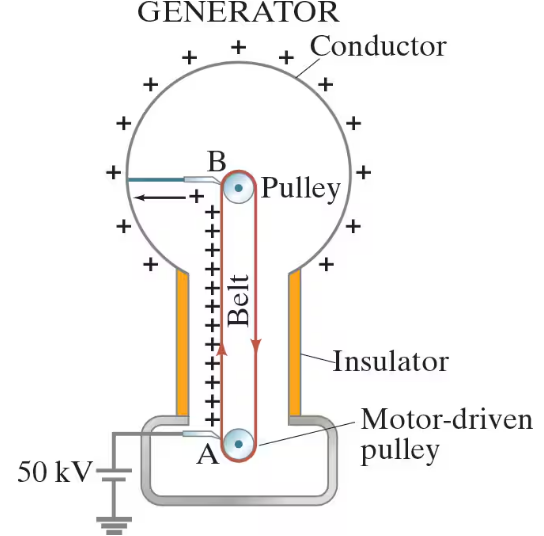
A Van de Graaff generator (Fig. 23–58) can develop a very large potential difference, even millions of volts. Electrons are pulled off the belt by the high voltage pointed electrode (positive) at A, leaving the belt positively charged. (Recall Example 23–5 where we saw that near sharp points the electric field is high and ionization can occur.) The belt carries the positive charge up inside the spherical shell where electrons from the large conducting sphere are attracted over to the pointed conductor at B, leaving the outer surface of the conducting sphere positively charged. As more charge is brought up, the sphere reaches extremely high voltage. Consider a Van de Graaff generator with a sphere of radius 0.20 m. What is the electric potential on the surface of the sphere when electrical breakdown occurs ( E = 3 x 10⁶ V/m) ? Assume V = 0 at r = ∞.
 Verified step by step guidance
Verified video answer for a similar problem:

Key Concepts
Electric Potential
 07:33
07:33
Electric Field Strength
 03:16
03:16Breakdown Voltage
 04:32
04:32Inside a high-voltage lab, engineers have designed a storage container for electrical energy using a nonconducting sphere of radius r2 that contains a concentric spherical cavity of radius r1. The material between r₁ and r₂ carries a uniform charge density ρE ( C/m³). Determine the electric potential V, relative to V = 0 at r = ∞, as a function of the distance r from the center for r > r₂.
A thin flat disk of radius R₀ carries a total charge Q that is distributed uniformly over its surface. The electric potential at a distance x on the x axis is given by V(x) = Q/ 2π∊₀R₀²[(x² + R²₀) ¹⸍² - x]. (See Example 23–10.) Show that the electric field at a distance x on the x axis is given by E(x) = Q/2π∊₀R₀² ( 1 - ( x / ( x² + R²₀))¹⸍². Make graphs of V(x) and E(x) as a function of x/R₀ for x/R₀ = 0 to 4. (Do the calculations in steps of 0.1.) Use Q = 5.0μC and R₀ = 10 cm for the calculation and graphs.
A Van de Graaff generator (Fig. 23–58) can develop a very large potential difference, even millions of volts. Electrons are pulled off the belt by the high voltage pointed electrode (positive) at A, leaving the belt positively charged. (Recall Example 23–5 where we saw that near sharp points the electric field is high and ionization can occur.) The belt carries the positive charge up inside the spherical shell where electrons from the large conducting sphere are attracted over to the pointed conductor at B, leaving the outer surface of the conducting sphere positively charged. As more charge is brought up, the sphere reaches extremely high voltage. Consider a Van de Graaff generator with a sphere of radius 0.20 m.
(b) What is the charge on the sphere for the potential found in part (a)