
Consider a sound wave in air that has displacement amplitude 0.0200 mm. Calculate the pressure amplitude for frequencies of (a) 150 Hz; (b) 1500 Hz; (c) 15,000 Hz. In each case compare the result to the pain threshold, which is 30 Pa.
Ch 16: Sound & Hearing
Young & Freedman Calc14th EditionUniversity PhysicsISBN: 9780321973610Not the one you use?Change textbook
Chapter 16, Problem 1a
Example 16.1 (Section 16.1) showed that for sound waves in air with frequency 1000 Hz, a displacement amplitude of 1.2 × 10⁻⁸ m produces a pressure amplitude of 3.0 × 10⁻² Pa. What is the wavelength of these waves?
Verified step by step guidance1
Start by recalling the relationship between the speed of sound, frequency, and wavelength. The formula is: , where is the speed of sound, is the frequency, and is the wavelength.
Identify the known values: the frequency is given as 1000 Hz. The speed of sound in air at room temperature is approximately 343 m/s.
Rearrange the formula to solve for the wavelength: .
Substitute the known values into the equation: .
Calculate the wavelength using the substituted values. This will give you the wavelength of the sound waves in meters.

Verified video answer for a similar problem:
This video solution was recommended by our tutors as helpful for the problem above.
Video duration:
3mWas this helpful?
Key Concepts
Here are the essential concepts you must grasp in order to answer the question correctly.
Sound Waves
Sound waves are longitudinal waves that travel through a medium, such as air, by compressing and rarefying the particles in the medium. The frequency of a sound wave determines its pitch, while the amplitude affects its loudness. Understanding sound waves involves analyzing their properties, such as frequency, wavelength, and amplitude.
Recommended video:
Guided course
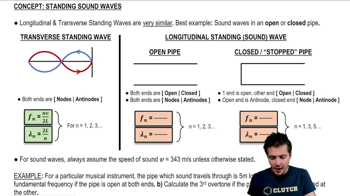
Standing Sound Waves
Frequency
Frequency is the number of oscillations or cycles a wave completes in one second, measured in Hertz (Hz). It is a crucial parameter in wave mechanics, influencing the energy and characteristics of the wave. In this context, a frequency of 1000 Hz indicates that the sound wave completes 1000 cycles per second.
Recommended video:
Guided course
Circumference, Period, and Frequency in UCM
Wavelength
Wavelength is the distance between consecutive points of a wave that are in phase, such as crest to crest or trough to trough. It is inversely related to frequency, meaning higher frequency waves have shorter wavelengths. To find the wavelength, one can use the wave equation: wavelength = speed of sound / frequency.
Recommended video:
Guided course
Unknown Wavelength of Laser through Double Slit
Related Practice
Textbook Question
2363
views
Textbook Question
A loud factory machine produces sound having a displacement amplitude of 1.00 mm, but the frequency of this sound can be adjusted. In order to prevent ear damage to the workers, the maximum pressure amplitude of the sound waves is limited to 10.0 Pa. Under the conditions of this factory, the bulk modulus of air is 1.42 × 10⁵ Pa. What is the highest-frequency sound to which this machine can be adjusted without exceeding the prescribed limit? Is this frequency audible to the workers?
1985
views
1
rank
Textbook Question
A metal bar with a length of 1.50 m has density 6400 kg/m3. Longitudinal sound waves take 3.90 × 10⁻⁴ s to travel from one end of the bar to the other. What is Young's modulus for this metal?
1545
views
