
Ch 17: Temperature and Heat
Young & Freedman Calc - University Physics 14th Edition
Young & Freedman Calc14th EditionUniversity PhysicsISBN: 9780321973610Not the one you use?Change textbook
Chapter 17, Problem 16

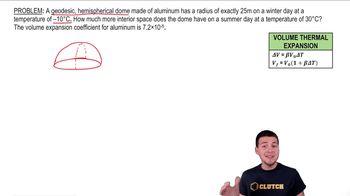
A geodesic dome constructed with an aluminum framework is a nearly perfect hemisphere; its diameter measures 55.0 m on a winter day at a temperature of -15°C. How much more interior space does the dome have in the summer, when the temperature is 35°C?

Verified step by step guidance
1
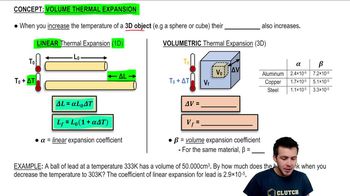
First, understand that the problem involves thermal expansion, which is the increase in volume of a material as its temperature increases. For a solid, the change in volume \( \Delta V \) can be calculated using the formula: \( \Delta V = \beta V_0 \Delta T \), where \( \beta \) is the coefficient of volume expansion, \( V_0 \) is the initial volume, and \( \Delta T \) is the change in temperature.
Calculate the initial volume \( V_0 \) of the hemisphere. The formula for the volume of a hemisphere is \( V = \frac{2}{3} \pi r^3 \). First, find the radius \( r \) by dividing the diameter by 2: \( r = \frac{55.0}{2} \) m.
Substitute the radius into the volume formula to find \( V_0 \): \( V_0 = \frac{2}{3} \pi (\frac{55.0}{2})^3 \).
Determine the change in temperature \( \Delta T \) by subtracting the initial temperature from the final temperature: \( \Delta T = 35°C - (-15°C) = 50°C \).
Use the coefficient of volume expansion for aluminum, \( \beta \approx 69 \times 10^{-6} \text{°C}^{-1} \), to calculate the change in volume \( \Delta V \) using the formula: \( \Delta V = \beta V_0 \Delta T \). This will give you the additional interior space in the summer.

Verified video answer for a similar problem:

This video solution was recommended by our tutors as helpful for the problem above.
Video duration:
5m
Was this helpful?

Key Concepts

Here are the essential concepts you must grasp in order to answer the question correctly.

Thermal Expansion

Thermal expansion refers to the tendency of matter to change in volume in response to a change in temperature. For solids like aluminum, this expansion is typically linear, meaning the material expands uniformly in all directions. The coefficient of linear expansion quantifies how much a material expands per degree of temperature change, which is crucial for calculating changes in the dome's dimensions.
Recommended video:
Guided course
05:21
Volume Thermal Expansion

Volume of a Hemisphere

The volume of a hemisphere is calculated using the formula V = (2/3)πr³, where r is the radius of the hemisphere. Understanding this formula is essential for determining the interior space of the dome. As the dome's diameter changes due to thermal expansion, the radius changes, affecting the volume calculation.
Recommended video:
Guided course
04:22
Expansion of a Hemispherical Dome

Temperature Conversion

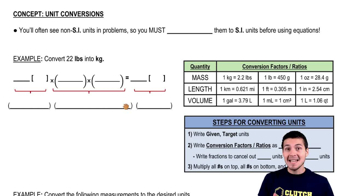
Temperature conversion is necessary to ensure consistent units when applying formulas involving thermal expansion. In this context, temperatures are given in Celsius, which is suitable for calculating changes in physical properties. Recognizing the temperature difference between winter and summer is key to determining the extent of expansion and its impact on the dome's volume.
Recommended video:
Guided course
07:46
Unit Conversions
Related Practice
Textbook Question

A 6.00-kg piece of solid copper metal at an initial temperature T is placed with 2.00 kg of ice that is initially at -20.0°C. The ice is in an insulated container of negligible mass and no heat is exchanged with the surroundings. After thermal equilibrium is reached, there is 1.20 kg of ice and 0.80 kg of liquid water. What was the initial temperature of the piece of copper?

576
views
Textbook Question

A steel tank is completely filled with 1.90 m3 of ethanol when both the tank and the ethanol are at 32.0°C. When the tank and its contents have cooled to 18.0°C, what additional volume of ethanol can be put into the tank?

1805
views
Textbook Question

One of the tallest buildings in the world is the Taipei 101 in Taiwan, at a height of 1671 feet. Assume that this height was measured on a cool spring day when the temperature was 15.5°C. You could use the building as a sort of giant thermometer on a hot summer day by carefully measuring its height. Suppose you do this and discover that the Taipei 101 is 0.471 foot taller than its official height. What is the temperature, assuming that the building is in thermal equilibrium with the air and that its entire frame is made of steel?

2523
views
Textbook Question

As a new mechanical engineer for Engines Inc., you have been assigned to design brass pistons to slide inside steel cylinders. The engines in which these pistons will be used will operate between 20.0°C and 150.0°C. Assume that the coefficients of expansion are constant over this temperature range. If the piston just fits inside the chamber at 20.0°C, will the engines be able to run at higher temperatures? Explain.

1620
views
Textbook Question

Like the Kelvin scale, the Rankine scale is an absolute temperature scale: Absolute zero is zero degrees Rankine (0°R). However, the units of this scale are the same size as those of the Fahrenheit scale rather than the Celsius scale. What is the numerical value of the triple-point temperature of water on the Rankine scale?

2204
views
Textbook Question

A constant-volume gas thermometer registers an absolute pressure corresponding to 325325 mm of mercury when in contact with water at the triple point. What pressure does it read when in contact with water at the normal boiling point?

2268
views