
Ch 17: Temperature and Heat
Young & Freedman Calc - University Physics 14th Edition
Young & Freedman Calc14th EditionUniversity PhysicsISBN: 9780321973610Not the one you use?Change textbook
Chapter 17, Problem 10

Like the Kelvin scale, the Rankine scale is an absolute temperature scale: Absolute zero is zero degrees Rankine (0°R). However, the units of this scale are the same size as those of the Fahrenheit scale rather than the Celsius scale. What is the numerical value of the triple-point temperature of water on the Rankine scale?

Verified step by step guidance
1
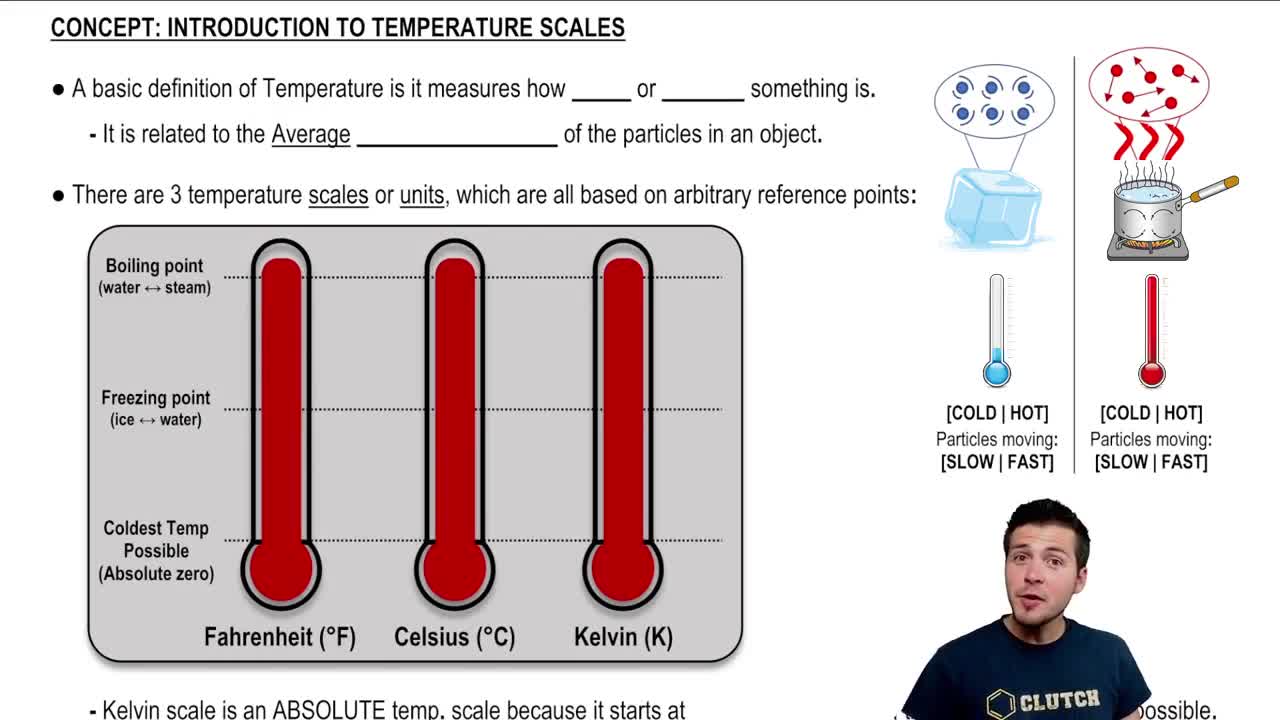
Understand the concept of the triple-point temperature of water, which is the temperature at which water can coexist in equilibrium in its solid, liquid, and gaseous states. This temperature is 0.01°C on the Celsius scale and 273.16 K on the Kelvin scale.
Recognize that the Rankine scale is an absolute temperature scale similar to the Kelvin scale, but it uses Fahrenheit-sized degrees. Therefore, the conversion between Kelvin and Rankine involves multiplying the Kelvin temperature by a factor to account for the difference in degree size.
Recall the conversion formula between Kelvin and Rankine: \( T_R = T_K \times \frac{9}{5} \), where \( T_R \) is the temperature in Rankine and \( T_K \) is the temperature in Kelvin.
Apply the conversion formula to the triple-point temperature of water: \( T_R = 273.16 \times \frac{9}{5} \). This will give you the temperature in degrees Rankine.
Perform the multiplication to find the numerical value of the triple-point temperature of water on the Rankine scale, ensuring that you maintain the precision of the calculation.

Verified video answer for a similar problem:

This video solution was recommended by our tutors as helpful for the problem above.
Video duration:
1m
Was this helpful?

Key Concepts

Here are the essential concepts you must grasp in order to answer the question correctly.

Absolute Temperature Scale

An absolute temperature scale is one where the zero point is absolute zero, the theoretical temperature at which particles have minimal thermal motion. The Kelvin and Rankine scales are examples, with Kelvin using Celsius-sized units and Rankine using Fahrenheit-sized units. Absolute scales are crucial for thermodynamic calculations.
Recommended video:
Guided course
04:54
Introduction To Temperature Scales

Triple Point of Water

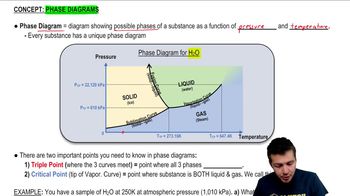
The triple point of water is the unique temperature and pressure at which water can coexist in equilibrium in its solid, liquid, and gaseous states. It is precisely defined as 273.16 Kelvin, which serves as a reference point for temperature scales. Understanding this concept is essential for converting temperatures between different scales.
Recommended video:
Guided course
06:59
Phase Diagrams

Temperature Conversion

Temperature conversion involves translating a temperature from one scale to another. For the Rankine scale, which uses Fahrenheit-sized units, the conversion from Kelvin involves multiplying by 1.8 (since 1 Kelvin equals 1.8 Rankine). This conversion is necessary to find the triple-point temperature of water in Rankine, which is 491.67°R.
Recommended video:
Guided course
07:46
Unit Conversions
Related Practice
Textbook Question

Calculate the one temperature at which Fahrenheit and Kelvin thermometers agree with each other

1136
views
Textbook Question

The pressure of a gas at the triple point of water is 1.351.35 atm. If its volume remains unchanged, what will its pressure be at the temperature at which CO2 solidifies?

1565
views
Textbook Question

A constant-volume gas thermometer registers an absolute pressure corresponding to 325325 mm of mercury when in contact with water at the triple point. What pressure does it read when in contact with water at the normal boiling point?

1219
views
Textbook Question

One of the tallest buildings in the world is the Taipei 101 in Taiwan, at a height of 1671 feet. Assume that this height was measured on a cool spring day when the temperature was 15.5°C. You could use the building as a sort of giant thermometer on a hot summer day by carefully measuring its height. Suppose you do this and discover that the Taipei 101 is 0.471 foot taller than its official height. What is the temperature, assuming that the building is in thermal equilibrium with the air and that its entire frame is made of steel?

1684
views
Textbook Question

A geodesic dome constructed with an aluminum framework is a nearly perfect hemisphere; its diameter measures 55.0 m on a winter day at a temperature of -15°C. How much more interior space does the dome have in the summer, when the temperature is 35°C?

1139
views
Textbook Question

A 6.00-kg piece of solid copper metal at an initial temperature T is placed with 2.00 kg of ice that is initially at -20.0°C. The ice is in an insulated container of negligible mass and no heat is exchanged with the surroundings. After thermal equilibrium is reached, there is 1.20 kg of ice and 0.80 kg of liquid water. What was the initial temperature of the piece of copper?

247
views