Ch 23: Electric Potential
Young & Freedman Calc - University Physics 14th Edition
Young & Freedman Calc14th EditionUniversity PhysicsISBN: 9780321973610Not the one you use?Change textbook
Chapter 23, Problem 1

A point charge q1=+2.40q_1=+2.40 μμC is held stationary at the origin. A second point charge q2=4.30q_2=-4.30 μμC moves from the point x=0.150x=0.150 m, y=0y=0 to the point x=0.250x=0.250 m, y=0.250y=0.250 m. How much work is done by the electric force on q2q_2?

Verified step by step guidance
1
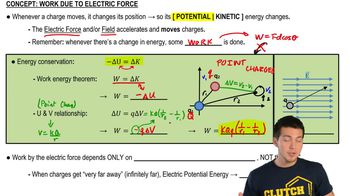
First, understand that the work done by the electric force is related to the change in electric potential energy as the charge q_2 moves from its initial position to its final position.
Calculate the initial electric potential energy (U_i) at the starting position (x=0.150 m, y=0) using the formula: U_i = (k * q_1 * q_2) / r_i, where k is Coulomb's constant (8.99 x 10^9 N m²/C²) and r_i is the initial distance between q_1 and q_2.
Determine the initial distance r_i between the charges using the distance formula: r_i = √((x_2 - x_1)^2 + (y_2 - y_1)^2), where (x_1, y_1) is the position of q_1 at the origin and (x_2, y_2) is the initial position of q_2.
Calculate the final electric potential energy (U_f) at the final position (x=0.250 m, y=0.250 m) using the formula: U_f = (k * q_1 * q_2) / r_f, where r_f is the final distance between q_1 and q_2.
Determine the final distance r_f using the distance formula: r_f = √((x_2 - x_1)^2 + (y_2 - y_1)^2), where (x_2, y_2) is the final position of q_2. The work done by the electric force is then given by the change in potential energy: Work = U_i - U_f.

Verified video answer for a similar problem:

This video solution was recommended by our tutors as helpful for the problem above.
Video duration:
7m
Was this helpful?

Key Concepts

Here are the essential concepts you must grasp in order to answer the question correctly.

Electric Force

Electric force is the interaction between charged particles, described by Coulomb's law. It is proportional to the product of the charges and inversely proportional to the square of the distance between them. In this scenario, the force acts on q_2 due to q_1, influencing its movement and the work done.
Recommended video:
Guided course
14:21
Work due to Electric Force

Work Done by a Force

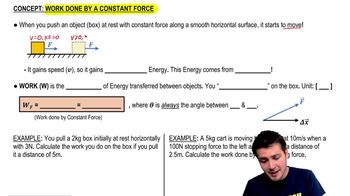
Work done by a force is the energy transferred when an object is moved by that force. It is calculated as the dot product of the force vector and the displacement vector. In this context, the work done by the electric force on q_2 is determined by the change in position and the force exerted by q_1.
Recommended video:
Guided course
06:09
Work Done by a Constant Force

Electric Potential Energy

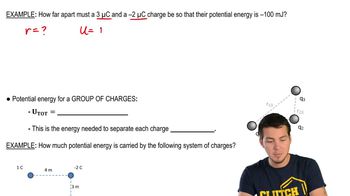
Electric potential energy is the energy a charge possesses due to its position in an electric field. It depends on the charge and the electric potential at its location. The change in electric potential energy as q_2 moves from one point to another is directly related to the work done by the electric force.
Recommended video:
Guided course
07:51
Electric Potential Energy