Pearson+ LogoPearson+ Logo
Ch 02: Kinematics in One Dimension
Knight Calc - Physics for Scientists and Engineers 5th Edition
Knight Calc5th EditionPhysics for Scientists and EngineersISBN: 9780137344796Not the one you use?Change textbook
Chapter 2, Problem 38b

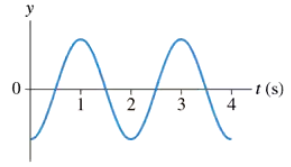
A block is suspended from a spring, pulled down, and released. The block's position-versus-time graph is shown in FIGURE P2.38. Draw a reasonable velocity-versus-time graph.

Verified step by step guidance
1
Analyze the position-versus-time graph provided. The graph shows a sinusoidal motion, indicating simple harmonic motion (SHM). The block oscillates around the equilibrium position (x = 0) with a periodic pattern.
Recall that velocity is the derivative of position with respect to time. For SHM, if the position x(t) is represented as a sine function, the velocity v(t) will be represented as a cosine function, but with a phase shift of π/2 radians (90 degrees).
Identify key points on the position graph: where the slope is zero (maximum or minimum position), the velocity will be zero. Where the slope is steepest (crossing the equilibrium position), the velocity will be at its maximum magnitude.
Sketch the velocity-versus-time graph. At t = 0, the position graph starts at a maximum, so the velocity graph will start at zero and decrease (negative slope). As the position decreases to zero, the velocity reaches its maximum negative value. When the position reaches a minimum, the velocity returns to zero, and so on.
Ensure the velocity graph is also sinusoidal but shifted by π/2 radians relative to the position graph. The amplitude of the velocity graph will depend on the angular frequency ω and the amplitude of the position graph, as v_max = ω * A.

Verified video answer for a similar problem:

This video solution was recommended by our tutors as helpful for the problem above.
Video duration:
6m
Was this helpful?

Key Concepts

Here are the essential concepts you must grasp in order to answer the question correctly.

Simple Harmonic Motion (SHM)

Simple Harmonic Motion is a type of periodic motion where an object oscillates around an equilibrium position. The motion is characterized by a restoring force proportional to the displacement from the equilibrium, leading to sinusoidal position, velocity, and acceleration graphs. In the context of a block on a spring, SHM describes how the block moves back and forth after being displaced.
Recommended video:
Guided course
07:52
Simple Harmonic Motion of Pendulums

Velocity-Time Graphs

A velocity-time graph represents the velocity of an object as a function of time. The slope of this graph indicates acceleration, while the area under the curve represents displacement. For a block undergoing SHM, the velocity graph will be sinusoidal, with maximum velocity at the equilibrium position and zero velocity at the maximum displacement points.
Recommended video:
Guided course
05:59
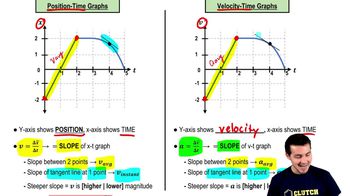
Velocity-Time Graphs & Acceleration

Phase Relationship between Position and Velocity

In SHM, there is a specific phase relationship between position and velocity. When the position is at its maximum (the block is at rest), the velocity is zero. Conversely, when the position is zero (the block passes through the equilibrium), the velocity reaches its maximum. This relationship is crucial for accurately drawing the velocity-time graph based on the given position-time graph.
Recommended video:
Guided course
03:43
Relationships Between Force, Field, Energy, Potential