Pearson+ LogoPearson+ Logo
Ch 03: Vectors and Coordinate Systems
Knight Calc - Physics for Scientists and Engineers 5th Edition
Knight Calc5th EditionPhysics for Scientists and EngineersISBN: 9780137344796Not the one you use?Change textbook
Chapter 3, Problem 10a

Draw each of the following vectors, label an angle that specifies the vector's direction, and then find the vector's magnitude and direction. A = 3.0i + 7.0j

Verified step by step guidance
1
Step 1: Understand the vector notation. The vector A = 3.0i + 7.0j is expressed in terms of its components along the x-axis (i) and y-axis (j). Here, 3.0 is the x-component, and 7.0 is the y-component.
Step 2: Draw the vector. On a Cartesian coordinate system, plot the point (3.0, 7.0). Start at the origin (0, 0) and draw an arrow pointing to this point. This arrow represents the vector A.
Step 3: Label the angle that specifies the vector's direction. The angle θ is measured counterclockwise from the positive x-axis to the vector. To find θ, use the formula θ = arctan(y/x), where y = 7.0 and x = 3.0.
Step 4: Calculate the magnitude of the vector. The magnitude is the length of the vector and can be found using the Pythagorean theorem: |A| = √(x² + y²). Substitute x = 3.0 and y = 7.0 into the formula.
Step 5: Combine the results. The magnitude |A| and the direction θ together fully describe the vector. Express the direction in degrees or radians, depending on the context, and ensure the magnitude is labeled with appropriate units.

Verified video answer for a similar problem:

This video solution was recommended by our tutors as helpful for the problem above.
Video duration:
2m
Was this helpful?

Key Concepts

Here are the essential concepts you must grasp in order to answer the question correctly.

Vector Representation

Vectors are quantities that have both magnitude and direction, represented in a coordinate system. In this case, the vector A = 3.0i + 7.0j is expressed in terms of its components along the x-axis (i) and y-axis (j). The coefficients indicate how far the vector extends in each direction, allowing for a graphical representation in a Cartesian plane.
Recommended video:
Guided course
06:44
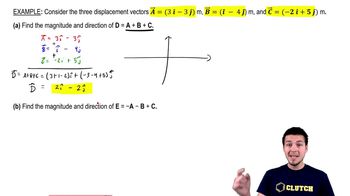
Adding 3 Vectors in Unit Vector Notation

Magnitude of a Vector

The magnitude of a vector is a measure of its length, calculated using the Pythagorean theorem. For vector A = 3.0i + 7.0j, the magnitude is found by taking the square root of the sum of the squares of its components: |A| = √(3.0² + 7.0²). This value provides a scalar quantity that represents how strong or large the vector is.
Recommended video:
Guided course
03:59
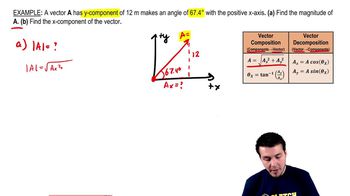
Calculating Magnitude & Components of a Vector

Direction of a Vector

The direction of a vector is specified by the angle it makes with a reference axis, typically the positive x-axis. This angle can be calculated using the arctangent function: θ = arctan(y/x), where y and x are the vector's components. For vector A, the direction can be determined by finding the angle corresponding to the components 3.0 and 7.0, which indicates the vector's orientation in the plane.
Recommended video:
Guided course
06:44
Adding 3 Vectors in Unit Vector Notation