Pearson+ LogoPearson+ Logo
Ch 03: Vectors and Coordinate Systems
Knight Calc - Physics for Scientists and Engineers 5th Edition
Knight Calc5th EditionPhysics for Scientists and EngineersISBN: 9780137344796Not the one you use?Change textbook
Chapter 3, Problem 13b

Let A = 2i + 3j, B = 2i - 4j, and C = A + B. Draw a coordinate system and on it show vectors A, B, and C.

Verified step by step guidance
1
Step 1: Understand the problem. You are given two vectors A and B in component form, and you need to find their sum (vector C). Additionally, you are asked to represent these vectors graphically on a coordinate system.
Step 2: Add the components of vectors A and B to find vector C. Use the formula for vector addition: \( C = A + B \). For the x-components, add \( 2 + 2 \), and for the y-components, add \( 3 - 4 \). This will give the components of vector C.
Step 3: Write the resulting vector C in component form. After performing the addition, vector C will be expressed as \( C = (x_{C})i + (y_{C})j \), where \( x_{C} \) and \( y_{C} \) are the calculated x and y components.
Step 4: Draw a coordinate system. Label the axes as x and y. Plot vector A starting from the origin, with its x-component (2) and y-component (3). Then plot vector B starting from the origin, with its x-component (2) and y-component (-4). Finally, plot vector C starting from the origin, using the components calculated in Step 3.
Step 5: Use arrows to represent the vectors on the graph. Ensure that the direction and magnitude of each vector are accurately represented. Label each vector (A, B, and C) clearly on the graph to complete the visualization.

Verified video answer for a similar problem:

This video solution was recommended by our tutors as helpful for the problem above.
Video duration:
3m
Was this helpful?

Key Concepts

Here are the essential concepts you must grasp in order to answer the question correctly.

Vector Addition

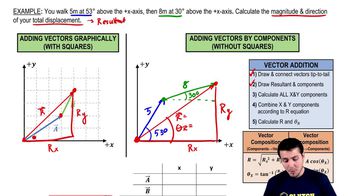
Vector addition involves combining two or more vectors to form a resultant vector. This is done by adding their corresponding components. For example, if vector A has components (2, 3) and vector B has components (2, -4), their sum, vector C, is obtained by adding the i-components and the j-components separately, resulting in C = (2+2)i + (3-4)j = 4i - 1j.
Recommended video:
Guided course
07:30
Vector Addition By Components

Coordinate System

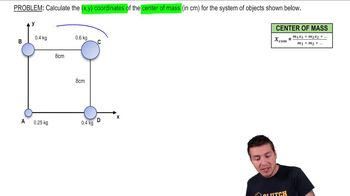
A coordinate system is a two-dimensional plane defined by two perpendicular axes, typically labeled as the x-axis (horizontal) and y-axis (vertical). Each point in this system can be represented by an ordered pair (x, y), where x indicates the position along the x-axis and y indicates the position along the y-axis. This system is essential for graphically representing vectors and their components.
Recommended video:
Guided course
05:17
Coordinates of Center of Mass of 4 objects

Vector Representation

Vectors can be represented graphically as arrows in a coordinate system, where the length of the arrow indicates the magnitude and the direction of the arrow indicates the vector's direction. For instance, vector A = 2i + 3j would be represented as an arrow starting from the origin (0,0) and pointing to the point (2,3) in the coordinate system. This visual representation helps in understanding the relationship between different vectors.
Recommended video:
Guided course
06:44
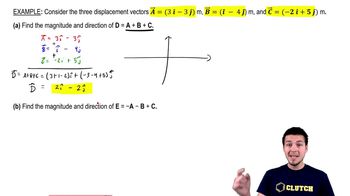
Adding 3 Vectors in Unit Vector Notation