Ch 03: Vectors and Coordinate Systems
Chapter 3, Problem 16b

Let A = 4i - 2j, B = -3i + 5j, and F = A - 4B. Draw a coordinate system and on it show vectors A, B, and F.

Verified step by step guidance
1
Step 1: Understand the problem. You are given two vectors A and B in component form, and you need to calculate a new vector F using the equation F = A - 4B. Additionally, you are asked to draw a coordinate system and represent the vectors A, B, and F graphically.
Step 2: Write down the given vectors in component form. Vector A is given as A = 4i - 2j, and vector B is given as B = -3i + 5j. The equation for F is F = A - 4B.
Step 3: Substitute the values of A and B into the equation for F. Using vector subtraction and scalar multiplication, calculate the components of F. For the i-component: F_i = A_i - 4 * B_i. For the j-component: F_j = A_j - 4 * B_j. Perform these operations symbolically without calculating the final numerical values.
Step 4: Once the components of F are determined, represent the vectors graphically. Draw a coordinate system with x-axis (i-direction) and y-axis (j-direction). Plot vector A starting from the origin, using its components (4, -2). Similarly, plot vector B starting from the origin, using its components (-3, 5). Finally, plot vector F using its calculated components.
Step 5: Label each vector clearly on the graph. Indicate the direction and magnitude of each vector using arrows. Ensure the graph is neat and accurately represents the relative positions and directions of A, B, and F.

Verified video answer for a similar problem:

This video solution was recommended by our tutors as helpful for the problem above.
Video duration:
4m
Was this helpful?

Key Concepts

Here are the essential concepts you must grasp in order to answer the question correctly.

Vector Representation

Vectors are quantities that have both magnitude and direction, represented in a coordinate system using components along the axes. In this case, vectors A and B are expressed in terms of their i (horizontal) and j (vertical) components, allowing for easy visualization and manipulation in a two-dimensional space.
Recommended video:
Guided course
06:44
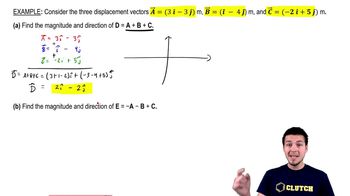
Adding 3 Vectors in Unit Vector Notation

Vector Addition and Subtraction

Vector addition and subtraction involve combining vectors to find a resultant vector. For example, in the expression F = A - 4B, vector B is scaled by a factor of 4 and then subtracted from vector A. This operation requires adding or subtracting the corresponding components of the vectors to determine the resultant vector F.
Recommended video:
Guided course
05:58
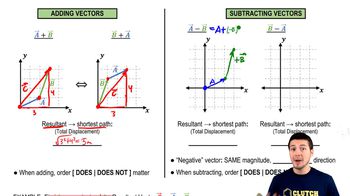
Subtracting Vectors Graphically

Coordinate System

A coordinate system provides a framework for locating points and vectors in space. In two dimensions, the Cartesian coordinate system uses perpendicular axes (x and y) to define positions. When drawing vectors A, B, and F, it is essential to accurately plot their components on this system to visualize their directions and magnitudes.
Recommended video:
Guided course
05:17
Coordinates of Center of Mass of 4 objects