Ch 04: Kinematics in Two Dimensions
Chapter 4, Problem 2a

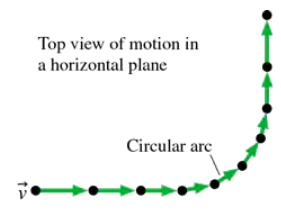
Complete the motion diagram by adding acceleration vectors.

Verified step by step guidance
1
Analyze the motion diagram: The purple arrows represent velocity vectors at different points along the trajectory. The object appears to follow a parabolic path, which is characteristic of projectile motion under gravity.
Understand the physics: In projectile motion, the acceleration vector is constant and directed downward due to gravity. This means the acceleration vectors should point vertically downward at every point in the motion diagram.
Add acceleration vectors: At each point in the motion diagram, draw a downward-pointing vector to represent the acceleration due to gravity. Ensure the vectors are of equal length, as the magnitude of gravitational acceleration is constant.
Interpret the motion: In the upward part of the trajectory, the velocity vectors decrease in magnitude (slowing down), while the acceleration remains downward. At the peak, the velocity is momentarily zero, but the acceleration is still downward. In the downward part of the trajectory, the velocity vectors increase in magnitude (speeding up) in the direction of the acceleration.
Verify consistency: Check that the acceleration vectors are consistent with the physics of the problem (constant downward direction and magnitude) and that they complement the velocity vectors shown in the diagram.

Verified video answer for a similar problem:

This video solution was recommended by our tutors as helpful for the problem above.
Video duration:
3m
Was this helpful?

Key Concepts

Here are the essential concepts you must grasp in order to answer the question correctly.

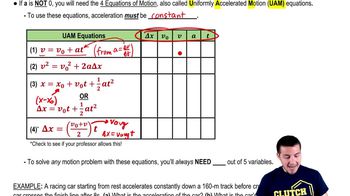
Kinematics

Kinematics is the branch of physics that describes the motion of objects without considering the forces that cause the motion. It involves concepts such as displacement, velocity, and acceleration, which are essential for analyzing how an object moves through space over time. Understanding kinematics is crucial for interpreting motion diagrams, as they visually represent the position and velocity of an object at various points in time.
Recommended video:
Guided course
08:25
Kinematics Equations

Acceleration

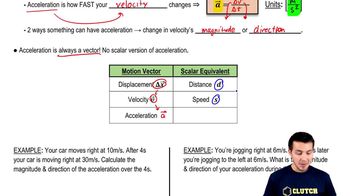
Acceleration is defined as the rate of change of velocity of an object with respect to time. It can be positive (speeding up), negative (slowing down), or zero (constant velocity). In motion diagrams, acceleration vectors indicate the direction and magnitude of this change, helping to illustrate how an object's speed and direction evolve throughout its path. Recognizing the role of acceleration is vital for completing motion diagrams accurately.
Recommended video:
Guided course
05:47
Intro to Acceleration

Vector Representation

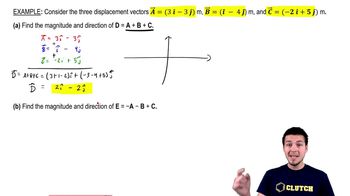
Vectors are quantities that have both magnitude and direction, making them essential for representing physical phenomena like velocity and acceleration. In motion diagrams, arrows are used to depict vectors, where the length indicates magnitude and the direction shows the vector's orientation. Understanding vector representation is key to interpreting motion diagrams, as it allows for a clear visualization of how an object's motion changes in two-dimensional space.
Recommended video:
Guided course
06:44
Adding 3 Vectors in Unit Vector Notation