
Textbook Question
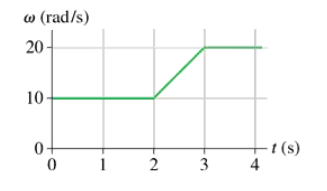
FIGURE EX4.24 shows the angular-position-versus-time graph for a particle moving in a circle. What is the particle's angular velocity at t = 4s
1884
views

 Verified step by step guidance
 06:18
06:18
 04:05
04:05 05:58
05:58FIGURE EX4.24 shows the angular-position-versus-time graph for a particle moving in a circle. What is the particle's angular velocity at t = 4s
A kayaker needs to paddle north across a 100-m-wide harbor. The tide is going out, creating a tidal current that flows to the east at 2.0 m/s. The kayaker can paddle with a speed of 3.0 m/s. How long will it take him to cross?
The earth's radius is about 4000 miles. Kampala, the capital of Uganda, and Singapore are both nearly on the equator. The distance between them is 5000 miles. The flight from Kampala to Singapore takes 9.0 hours. What is the plane's angular velocity with respect to the earth's surface? Give your answer in °/h.
On the Apollo 14 mission to the moon, astronaut Alan Shepard hit a golf ball with a 6 iron. The free-fall acceleration on the moon is 1/6 of its value on earth. Suppose he hit the ball with a speed of 25 m/s at an angle 30 degrees above the horizontal. For how much more time was the ball in flight?
As the earth rotates, what is the speed of a physics student in Miami, Florida, at latitude 26°. Ignore the revolution of the earth around the sun. The radius of the earth is 6400 km.
Susan, driving north at 60 mph, and Trent, driving east at 45 mph, are approaching an intersection. What is Trent's speed relative to Susan's reference frame?