Pearson+ LogoPearson+ Logo
Ch 08: Dynamics II: Motion in a Plane
Knight Calc - Physics for Scientists and Engineers 5th Edition
Knight Calc5th EditionPhysics for Scientists and EngineersISBN: 9780137344796Not the one you use?Change textbook
Chapter 8, Problem 40a

An object of mass m swings in a horizontal circle on a string of length L that tilts downward at angle θ. Find an expression for the angular velocity ω.

Verified step by step guidance
1
Step 1: Begin by analyzing the forces acting on the object. The tension in the string has two components: a vertical component that balances the gravitational force (mg) and a horizontal component that provides the centripetal force for circular motion.
Step 2: Write the force balance equations. Vertically, the tension's vertical component is T⋅cos(θ), which equals the gravitational force: T⋅cos(θ) = m⋅g. Horizontally, the tension's horizontal component is T⋅sin(θ), which provides the centripetal force: T⋅sin(θ) = m⋅ω²⋅r, where r is the radius of the circular motion.
Step 3: Express the radius of the circular motion in terms of the string length L and the angle θ. The radius is given by r = L⋅sin(θ). Substitute this expression for r into the horizontal force equation.
Step 4: Solve the vertical force equation for T: T = m⋅g / cos(θ). Substitute this expression for T into the horizontal force equation to eliminate T.
Step 5: Rearrange the resulting equation to isolate ω. You should find that ω² = (g⋅tan(θ)) / L, and therefore ω = √((g⋅tan(θ)) / L). This is the expression for the angular velocity.

Verified video answer for a similar problem:

This video solution was recommended by our tutors as helpful for the problem above.
Was this helpful?

Key Concepts

Here are the essential concepts you must grasp in order to answer the question correctly.

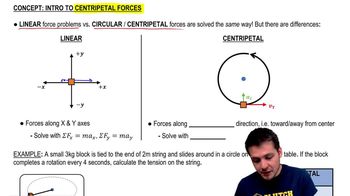
Centripetal Force

Centripetal force is the net force acting on an object moving in a circular path, directed towards the center of the circle. In this scenario, the tension in the string provides the necessary centripetal force to keep the mass m moving in a horizontal circle. Understanding how this force relates to the object's mass, velocity, and radius is crucial for deriving the angular velocity.
Recommended video:
Guided course
06:48
Intro to Centripetal Forces

Angular Velocity

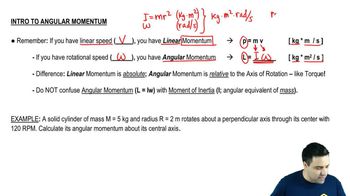
Angular velocity (ω) is a measure of how quickly an object rotates or revolves around a central point, expressed in radians per second. It is related to the linear velocity (v) of the object and the radius (r) of the circular path by the equation v = ωr. In this problem, finding the expression for ω involves relating the forces acting on the mass to its motion in the circular path.
Recommended video:
Guided course
06:18
Intro to Angular Momentum

Trigonometric Relationships in Circular Motion

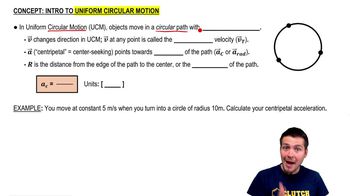
In problems involving circular motion, trigonometric functions help relate the angles and lengths of sides in right triangles formed by the motion. The angle θ affects the vertical and horizontal components of the forces acting on the mass. By applying sine and cosine functions, one can resolve the forces and derive relationships necessary to find the angular velocity in this tilted circular motion scenario.
Recommended video:
Guided course
03:48
Intro to Circular Motion